
What Is a Digital Signature Certificate (DSC)?
A Digital Signature Certificate (DSC) is an electronic credential used to authenticate the identity of an individual or organization when digitally signing documents, filing statutory returns, participating in online tenders or completing secure electronic transactions.
In India, Digital Signature Certificates are issued by licensed Certifying Authorities (CAs) operating under the regulatory framework established by the Information Technology Act, 2000.
A DSC uses Public Key Infrastructure (PKI) technology to provide authentication, document integrity and cryptographic proof that a particular private key was used to create a digital signature.
Digital Signature Certificates have become an essential requirement for businesses, professionals, company directors, government contractors and organizations that conduct legally significant transactions online.
We recognize that businesses increasingly depend on digital platforms for regulatory compliance, financial transactions and government services. A valid DSC enables authorized users to sign electronic documents securely without relying on traditional handwritten signatures.
Digital Signature Request Form
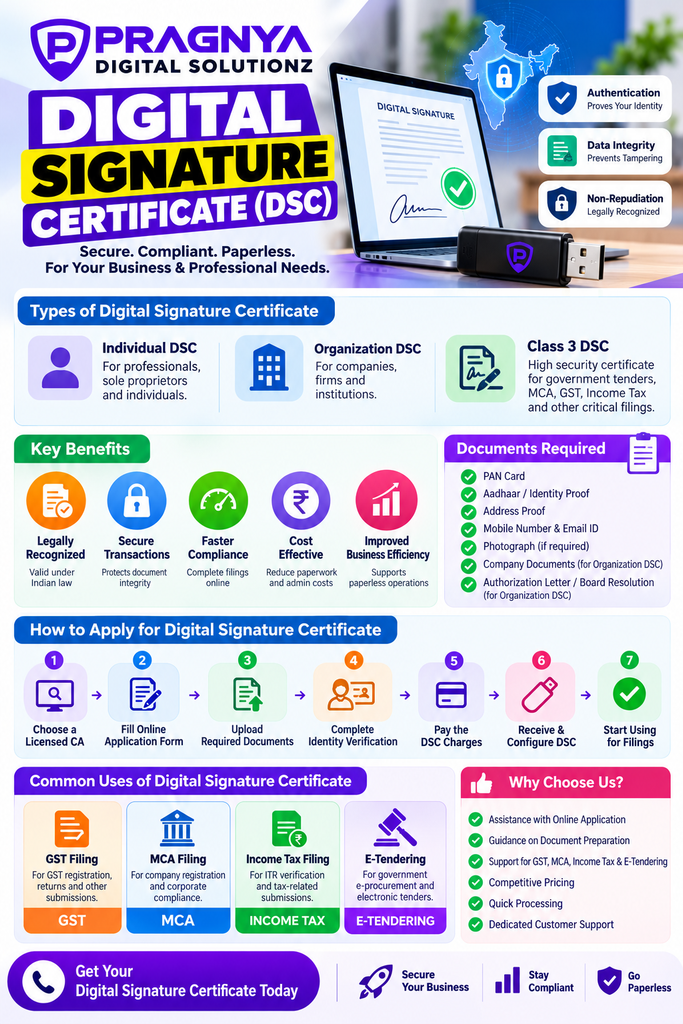
How Does a Digital Signature Certificate Works?
A Digital Signature Certificate operates through asymmetric cryptography, which uses two mathematically related keys:
- Private Key: A confidential cryptographic key used to generate digital signatures.
- Public Key: A corresponding key used to verify digital signatures.
When a document is digitally signed, cryptographic algorithms create a signature associated with the document’s contents.
The recipient can verify the signature using the signer’s public key and certificate.
This process helps establish three important security properties.
1. Authentication
A DSC helps verify the identity associated with a digital signature. Identity validation is performed by the issuing Certifying Authority according to applicable requirements.
2. Data Integrity
A digital signature allows recipients to detect whether signed document content has been modified after signing.
3. Non-Repudiation
Digital signatures provide evidence linking a signing operation to a particular cryptographic key. This can support non-repudiation, although the legal significance of a signature depends on the surrounding circumstances and applicable law.
Uses & Types of Digital Signature Certificates in India
Understanding the different categories of DSC is essential before applying for a certificate.
Class 3 Digital Signature Certificate
A Class 3 Digital Signature Certificate is commonly used for high-assurance online transactions, statutory filings and electronic procurement activities.
Typical applications include:
- MCA company filings
- GST-related digital signing where supported or required
- Income tax electronic filings
- Government e-tendering
- Electronic procurement portals
- Online auctions
- Corporate regulatory submissions
- Other authenticated electronic transactions
Class 3 certificates involve identity verification procedures prescribed under the applicable Certifying Authority framework.
Individual Digital Signature Certificate
An Individual DSC is issued to a verified person.
It is commonly used by:
- Chartered accountants
- Company directors
- Company secretaries
- Tax professionals
- Business owners
- Individual government contractors
- Authorized professionals
Organization Digital Signature Certificate
An Organization DSC includes information associating the certificate holder with an organization, subject to the issuing authority’s verification procedures.
Such certificates are useful when authorized representatives sign documents on behalf of companies, firms or institutions.
Signing and Encryption Certificates
Digital certificates can serve different cryptographic purposes.
| Certificate Type | Primary Purpose |
|---|---|
| Signing DSC | Digitally signing electronic documents |
| Encryption Certificate | Encrypting information for confidentiality |
| Combined Signing and Encryption | Supporting both functions where permitted and offered |
Important: Older Class 1 and Class 2 DSC references may still appear in outdated online guides. Applicants should check the current certificate categories and requirements rather than assuming those older classifications remain available.
Benefits of a Digital Signature Certificate
Legally Recognized Electronic Signatures
Digital signatures created in accordance with applicable Indian law can receive legal recognition under the Information Technology Act, 2000.
This makes them valuable for many business and government transactions.
However, not every document or transaction is automatically eligible for electronic execution. Certain legal exclusions and procedural requirements may apply.
Improved Document Security
A DSC helps protect document integrity through cryptographic verification.
Unauthorized changes to signed document content can generally be detected during signature validation.
Faster Business Transactions
Digital signing reduces dependence on physical paperwork, courier services and in-person document exchange.
Organizations can complete many compliance activities remotely.
Reduced Administrative Costs
Businesses can reduce expenditure associated with printing, scanning, transporting and storing physical documents.
Convenient Online Compliance
A valid DSC can support multiple online compliance processes, depending on the requirements of each government or business portal.
Improved Business Efficiency
Digital signatures simplify approval processes and support paperless business operations.
For organizations handling large volumes of electronic documents, DSC-based signing can significantly improve workflow efficiency.
Documents Required for Digital Signature Certificate Registration
The documents required for a DSC application in India depend on the applicant category, the certificate type and the issuing Certifying Authority.
Documents for Individual DSC
Common requirements may include:
- PAN card or another accepted identity document
- Aadhaar or another accepted address or identity document
- Mobile number
- Email address
- Recent photograph, where required
- Identity verification through an approved process
Documents for Organization DSC
Organizations may need additional documentation, such as:
- Company registration or incorporation certificate
- Organization PAN
- Proof of registered business address
- Authorization letter or board resolution, where applicable
- Authorized representative’s identity documents
- Other organizational verification records
The exact document list should always be confirmed with the selected licensed Certifying Authority.
How to Apply for a Digital Signature Certificate Online in India
Obtaining a Digital Signature Certificate is generally straightforward when applicants prepare their documents and complete the required verification.
Step 1: Select a Licensed Certifying Authority
We recommend selecting a Certifying Authority licensed under India’s Controller of Certifying Authorities.
Applicants can review regulatory information through the official Controller of Certifying Authorities website.
Step 2: Choose the Appropriate DSC
Select the certificate according to the intended use.
For example, a contractor participating in electronic government tenders may need a Class 3 signing certificate that meets the tender portal’s requirements.
Step 3: Complete the DSC Application Form
Applicants generally provide:
- Full legal name
- Contact details
- Identity information
- Address details
- Organization information, if applicable
- Required certificate validity
Step 4: Submit Supporting Documents
Upload the requested identity and address documents using the application process provided by the Certifying Authority or its authorized registration channel.
Step 5: Complete Identity Verification
The issuing authority may require video verification, Aadhaar-based verification or another approved identity verification procedure.
Available methods vary by provider and applicant category.
Step 6: Pay the Applicable DSC Charges
Certificate charges depend on the provider, certificate type, validity period and whether a hardware token is included.
Step 7: Receive and Configure the DSC
After successful verification and approval, the certificate is issued and configured using the supported signing environment.
Some workflows require a compatible cryptographic USB token and signing software.
Step 8: Test the Digital Signature
Before using the DSC for statutory filings or electronic tendering, verify that the certificate works with the intended portal.
Digital Signature Certificate Price in India
Completing business registrations, submitting government tenders, filing company documents and handling online tax compliance often requires a legally recognised digital signature. This is where a Digital Signature Certificate (DSC) becomes important.
However, before applying for one, most people have a practical question: How much money should I actually spend on a Digital Signature Certificate in India?
The answer depends on what you intend to do with your certificate. Someone who needs a DSC for personal document signing may have different requirements from a company director filing MCA documents or a contractor participating in government tenders.
The certificate type, validity, USB cryptographic token and application assistance can all influence the final price.
This guide explains the different DSC price categories in India, what you are paying for, how to avoid unnecessary expenses and how to select the right certificate for your requirements.
Digital Signature Certificate Price in India: What Should You Expect?
There is no single retail price applicable to every Digital Signature Certificate. Licensed Certifying Authorities and their authorised service providers offer different pricing depending on the certificate category and services included.
For general budgeting, the following are indicative price ranges for commonly requested Class 3 certificates.
| Certificate Category | Validity | Approximate Price |
|---|---|---|
| Individual Signing DSC | 1 Year | ₹800–₹1,500 |
| Individual Signing DSC | 2 Years | ₹1,000–₹2,000 |
| Individual Signing DSC | 3 Years | ₹1,500–₹2,500 |
| Organisation Signing DSC | 1 Year | ₹800–₹1,800 |
| Organisation Signing DSC | 2 Years | ₹1,200–₹2,200 |
| Organisation Signing DSC | 3 Years | ₹1,600–₹2,800 |
| Signing + Encryption DSC | 1 Year | ₹1,500–₹2,500 |
| Signing + Encryption DSC | 2 Years | ₹2,000–₹3,500 |
| Signing + Encryption DSC | 3 Years | ₹3,000–₹4,500 |
Note: These are indicative budgeting estimates, not official government rates or guaranteed quotations. The actual amount may vary. Confirm whether GST, USB token, delivery and application assistance are included before purchasing.
Why Do Digital Signature Certificate Prices Differ?
Two providers may advertise different prices for what appears to be the same DSC. This does not necessarily mean that one certificate is better than the other.
The difference usually comes from the package and the services included.
1. Certificate functionality
A certificate intended only for digital signing may cost less than a combination certificate that supports both signing and encryption.
2. Validity period
A certificate with a longer validity period may have a higher initial cost. However, it can be more economical for someone who regularly uses digital signatures.
3. USB cryptographic token
Some providers include a USB token in their advertised package, while others charge separately. The token is a secure device used to store and protect the certificate’s private key.
4. Verification and application support
Depending on the provider, the package may include assistance with document submission, identity verification and installation.
5. Taxes and delivery
GST and physical delivery charges can increase the final amount payable.
A useful purchasing tip is to compare the final payable price rather than selecting a provider simply because its advertisement displays the lowest starting price.
Which Digital Signature Certificate Do You Need?
Choosing the correct DSC is more important than choosing the cheapest one. Your requirement should determine the certificate you purchase.
1. Individual Digital Signature Certificate
An individual DSC is issued in the name of a person. It is suitable for professionals, independent consultants, taxpayers and individuals who need to authenticate electronic documents.
For example, a chartered accountant may use a compatible DSC for professional filings, while an individual business owner may require one for online compliance.
2. Organisation-Related Digital Signature Certificate
Businesses frequently require digital signatures from their directors, partners or authorised representatives.
For example, a private limited company may need its director to digitally sign documents submitted to the Ministry of Corporate Affairs.
An important distinction is that a DSC identifies the individual certificate holder. It does not simply function as a digital identity issued in the company’s name.
3. Signing Digital Signature Certificate
A signing certificate is designed to authenticate electronic documents and confirm the identity of the person signing them.
Typical applications include:
-
Income Tax e-filing.
-
GST-related submissions.
-
MCA and ROC filings.
-
Digital signing of business documents.
-
Government portal applications.
4. Encryption Digital Signature Certificate
Encryption certificates are used to protect electronic information so that only the intended recipient can access it.
They serve a different purpose from signing certificates. You should purchase one only when your intended application or portal requires encryption functionality.
5. Signing and Encryption Combo DSC
A combo certificate provides both signing and encryption capabilities.
It may be suitable for users whose professional or business activities require both functions. However, not every government portal requires a combo certificate.
Always check the applicable technical requirements before ordering.
Which Professionals and Businesses Commonly Need a DSC?
A DSC is useful across several industries because many official transactions are now conducted electronically.
| User Category | Common Requirement |
|---|---|
| Company Directors | MCA and ROC compliance |
| Chartered Accountants | Tax and professional filings |
| Government Contractors | E-tender participation |
| Business Owners | Electronic document signing |
| Importers and Exporters | Relevant customs and trade portal activities |
| Legal Professionals | Electronic document authentication |
| Consultants | Signing official business documents |
| Organisations | Authorised electronic submissions |
The exact certificate type depends on the portal, activity and role of the applicant.
Is a USB Token Included in the DSC Price?
This is one of the most overlooked aspects when comparing DSC prices.
A USB cryptographic token is a hardware security device used to store the certificate’s private key. It helps protect the signing credentials and is commonly used with token-based DSC applications.
When comparing quotations, check these details:
-
Is the USB token included?
-
Is the token compatible with your operating system?
-
Are installation instructions provided?
-
Is GST included?
-
Are delivery charges additional?
-
Is technical support available if installation fails?
A package advertised at a lower price may become more expensive once these additional charges are included.
Documents Required for a Digital Signature Certificate
The documentation depends on the applicant category and the verification procedure followed by the Certifying Authority.
For individuals, commonly requested details include:
-
PAN Card.
-
Aadhaar Card or another accepted identity document.
-
Active mobile number.
-
Working email address.
-
Address proof, if required.
-
Photograph, where applicable.
For organisation-related applications, additional information may be necessary:
-
Applicant’s PAN and identity documents.
-
Organisation PAN details.
-
Proof of association with the organisation.
-
Authorisation letter, where applicable.
-
Other supporting documents requested by the provider.
Applicants should follow the current documentation checklist of their selected Certifying Authority.
How to Apply for a Digital Signature Certificate Online
Applying for a DSC does not usually require a complicated process. You can complete the application through a licensed Certifying Authority or an authorised registration partner.
Step 1: Identify your requirement
Decide whether you need an individual or organisation-related DSC and whether signing or encryption functionality is required.
Step 2: Select the validity period
Choose an available validity period based on how frequently you use the certificate and your budget.
Step 3: Submit the application
Enter your personal or organisational details through the provider’s application system.
Step 4: Complete verification
Follow the prescribed identity verification procedure. This may involve Aadhaar-based eKYC, video verification or another accepted method.
Step 5: Complete payment
Pay the applicable certificate charges and any additional fees for the USB token, GST or service assistance.
Step 6: Receive and configure the certificate
Once approved and issued, follow the provider’s instructions to install and use your DSC.
How to Check Whether a DSC Provider Is Genuine
A Digital Signature Certificate is a security-sensitive product. Therefore, choosing an authorised provider is just as important as comparing prices.
Before making payment, consider the following:
-
Check whether the certificate is issued by a licensed Certifying Authority.
-
Verify the provider’s association with the issuing authority.
-
Ask for a complete price breakdown.
-
Confirm the certificate type and validity period.
-
Check whether the USB token is included.
-
Avoid sharing your token PIN or private key with anyone.
-
Ask about technical support and installation assistance.
You can refer to the Controller of Certifying Authorities (CCA), Ministry of Electronics and Information Technology, for information about licensed Certifying Authorities in India.
Official website: https://cca.gov.in/
Frequently Asked Questions About DSC Prices in India
What is the minimum price of a Digital Signature Certificate in India?
A basic Class 3 signing DSC may be available from approximately ₹800, depending on the provider and package. Additional charges may apply for GST, USB tokens and application assistance.
What is the price of a 3-year Class 3 DSC?
A three-year Class 3 signing certificate may cost approximately ₹1,500–₹2,500. A signing and encryption combo can cost more depending on the issuing authority and included services.
Is a Class 3 DSC required for GST filing?
The requirement depends on the taxpayer category and applicable GST portal rules. Where a digital signature is required, the certificate must meet the portal’s accepted specifications.
Can I use the same DSC for MCA and Income Tax filing?
A compatible individual DSC may be usable across multiple portals, subject to their technical requirements and registration procedures.
Can I get a DSC without a USB token?
Some certificate arrangements may use different storage or authentication methods. However, if you purchase a token-based DSC, you need a compatible cryptographic token to use it.
Is a Digital Signature Certificate compulsory for every business?
No. The requirement depends on the nature of the business, applicable regulations and the online activities being performed.
Can I renew my DSC after expiry?
You generally need to obtain a fresh certificate or follow the issuing authority’s applicable renewal or reissue procedure. Do not assume an expired certificate can continue to be used.
Is a Digital Signature Certificate legally recognised in India?
Yes. Digital signatures meeting the applicable requirements of the Information Technology Act, 2000, receive legal recognition in India.
Final Thoughts: Compare DSC Prices Before You Apply
A Digital Signature Certificate is not just another online service purchase. It is a security credential that may be used for important financial, professional and business transactions.
Before selecting a package, identify your actual requirement, compare the available validity periods and check whether the advertised price includes the USB token, taxes and application assistance.
A little attention to these details can help you avoid unnecessary expenses and delays.
If you are applying for a DSC for the first time, make sure you understand the difference between signing and encryption certificates before placing your order.