
Digital Signature Certificate Request Form
What Is a Digital Signature Certificate (DSC)?
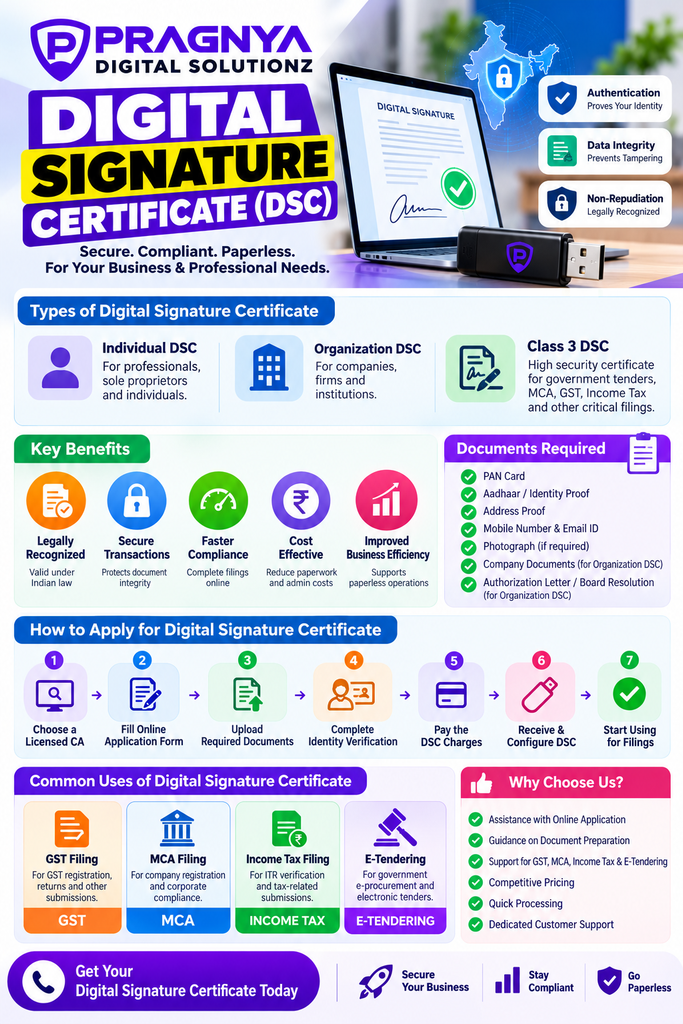
A Digital Signature Certificate (DSC) is an electronic credential used to authenticate the identity of an individual or organization when digitally signing documents, filing statutory returns, participating in online tenders or completing secure electronic transactions.
In India, Digital Signature Certificates are issued by licensed Certifying Authorities (CAs) operating under the regulatory framework established by the Information Technology Act, 2000.
A DSC uses Public Key Infrastructure (PKI) technology to provide authentication, document integrity and cryptographic proof that a particular private key was used to create a digital signature.
Digital Signature Certificates have become an essential requirement for businesses, professionals, company directors, government contractors and organizations that conduct legally significant transactions online.
We recognize that businesses increasingly depend on digital platforms for regulatory compliance, financial transactions and government services. A valid DSC enables authorized users to sign electronic documents securely without relying on traditional handwritten signatures.
How Does a Digital Signature Certificate Work?
A Digital Signature Certificate operates through asymmetric cryptography, which uses two mathematically related keys:
- Private Key: A confidential cryptographic key used to generate digital signatures.
- Public Key: A corresponding key used to verify digital signatures.
When a document is digitally signed, cryptographic algorithms create a signature associated with the document’s contents.
The recipient can verify the signature using the signer’s public key and certificate.
This process helps establish three important security properties.
1. Authentication
A DSC helps verify the identity associated with a digital signature. Identity validation is performed by the issuing Certifying Authority according to applicable requirements.
2. Data Integrity
A digital signature allows recipients to detect whether signed document content has been modified after signing.
3. Non-Repudiation
Digital signatures provide evidence linking a signing operation to a particular cryptographic key. This can support non-repudiation, although the legal significance of a signature depends on the surrounding circumstances and applicable law.
Types of Digital Signature Certificates in India
Understanding the different categories of DSC is essential before applying for a certificate.
Class 3 Digital Signature Certificate
A Class 3 Digital Signature Certificate is commonly used for high-assurance online transactions, statutory filings and electronic procurement activities.
Typical applications include:
- MCA company filings
- GST-related digital signing where supported or required
- Income tax electronic filings
- Government e-tendering
- Electronic procurement portals
- Online auctions
- Corporate regulatory submissions
- Other authenticated electronic transactions
Class 3 certificates involve identity verification procedures prescribed under the applicable Certifying Authority framework.
Individual Digital Signature Certificate
An Individual DSC is issued to a verified person.
It is commonly used by:
- Chartered accountants
- Company directors
- Company secretaries
- Tax professionals
- Business owners
- Individual government contractors
- Authorized professionals
Organization Digital Signature Certificate
An Organization DSC includes information associating the certificate holder with an organization, subject to the issuing authority’s verification procedures.
Such certificates are useful when authorized representatives sign documents on behalf of companies, firms or institutions.
Signing and Encryption Certificates
Digital certificates can serve different cryptographic purposes.
| Certificate Type | Primary Purpose |
|---|---|
| Signing DSC | Digitally signing electronic documents |
| Encryption Certificate | Encrypting information for confidentiality |
| Combined Signing and Encryption | Supporting both functions where permitted and offered |
Important: Older Class 1 and Class 2 DSC references may still appear in outdated online guides. Applicants should check the current certificate categories and requirements rather than assuming those older classifications remain available.
Benefits of a Digital Signature Certificate
Legally Recognized Electronic Signatures
Digital signatures created in accordance with applicable Indian law can receive legal recognition under the Information Technology Act, 2000.
This makes them valuable for many business and government transactions.
However, not every document or transaction is automatically eligible for electronic execution. Certain legal exclusions and procedural requirements may apply.
Improved Document Security
A DSC helps protect document integrity through cryptographic verification.
Unauthorized changes to signed document content can generally be detected during signature validation.
Faster Business Transactions
Digital signing reduces dependence on physical paperwork, courier services and in-person document exchange.
Organizations can complete many compliance activities remotely.
Reduced Administrative Costs
Businesses can reduce expenditure associated with printing, scanning, transporting and storing physical documents.
Convenient Online Compliance
A valid DSC can support multiple online compliance processes, depending on the requirements of each government or business portal.
Improved Business Efficiency
Digital signatures simplify approval processes and support paperless business operations.
For organizations handling large volumes of electronic documents, DSC-based signing can significantly improve workflow efficiency.
Documents Required for Digital Signature Certificate Registration
The documents required for a DSC application in India depend on the applicant category, the certificate type and the issuing Certifying Authority.
Documents for Individual DSC
Common requirements may include:
- PAN card or another accepted identity document
- Aadhaar or another accepted address or identity document
- Mobile number
- Email address
- Recent photograph, where required
- Identity verification through an approved process
Documents for Organization DSC
Organizations may need additional documentation, such as:
- Company registration or incorporation certificate
- Organization PAN
- Proof of registered business address
- Authorization letter or board resolution, where applicable
- Authorized representative’s identity documents
- Other organizational verification records
The exact document list should always be confirmed with the selected licensed Certifying Authority.
How to Apply for a Digital Signature Certificate Online in India
Obtaining a Digital Signature Certificate is generally straightforward when applicants prepare their documents and complete the required verification.
Step 1: Select a Licensed Certifying Authority
We recommend selecting a Certifying Authority licensed under India’s Controller of Certifying Authorities.
Applicants can review regulatory information through the official Controller of Certifying Authorities website.
Step 2: Choose the Appropriate DSC
Select the certificate according to the intended use.
For example, a contractor participating in electronic government tenders may need a Class 3 signing certificate that meets the tender portal’s requirements.
Step 3: Complete the DSC Application Form
Applicants generally provide:
- Full legal name
- Contact details
- Identity information
- Address details
- Organization information, if applicable
- Required certificate validity
Step 4: Submit Supporting Documents
Upload the requested identity and address documents using the application process provided by the Certifying Authority or its authorized registration channel.
Step 5: Complete Identity Verification
The issuing authority may require video verification, Aadhaar-based verification or another approved identity verification procedure.
Available methods vary by provider and applicant category.
Step 6: Pay the Applicable DSC Charges
Certificate charges depend on the provider, certificate type, validity period and whether a hardware token is included.
Step 7: Receive and Configure the DSC
After successful verification and approval, the certificate is issued and configured using the supported signing environment.
Some workflows require a compatible cryptographic USB token and signing software.
Step 8: Test the Digital Signature
Before using the DSC for statutory filings or electronic tendering, verify that the certificate works with the intended portal.
Digital Signature Certificate Price in India
The cost of a Digital Signature Certificate varies according to the issuing authority, certificate validity, applicant category, hardware requirements and service charges.
The following table illustrates the main factors affecting pricing rather than fixed market rates.
| Pricing Factor | How It Affects Cost |
|---|---|
| DSC category | Different certificate purposes may have different fees |
| Validity period | Longer validity may affect the total charge |
| Individual or organization | Organization verification may involve additional requirements |
| USB token | Hardware may be charged separately |
| Registration assistance | Service providers may charge additional fees |
| Taxes | Applicable GST may increase the final price |
Before purchasing a DSC online, we recommend obtaining a complete quotation that identifies the certificate fee, hardware token cost, taxes and any assistance charges.
Avoid selecting a DSC provider solely because it advertises the lowest price. Confirm that the certificate is issued by a licensed Certifying Authority and is compatible with the platform where it will be used.
Digital Signature Certificate for GST Registration and Filing
A Digital Signature Certificate for GST is useful for businesses that must digitally authenticate certain GST-related applications, returns and other submissions.
Under GST procedures, digital signing requirements depend on the type of registered taxpayer and the applicable filing process.
For example, companies and limited liability partnerships generally have mandatory DSC-based authentication requirements for relevant GST submissions.
Other eligible taxpayers may have alternative authentication methods, subject to portal rules.
We recommend checking the current requirements on the official GST Portal before purchasing a certificate specifically for GST use.
Digital Signature Certificate for MCA and Company Directors
The Ministry of Corporate Affairs (MCA) uses digital authentication for numerous corporate compliance processes.
A valid DSC is important for company directors, authorized signatories and professionals submitting electronic corporate forms.
Common uses include:
- Company incorporation-related filings
- Annual compliance submissions
- Director-related forms
- Corporate changes and statutory filings
- Professional certification of applicable electronic forms
Users may need to register or associate their DSC with the relevant MCA account before completing electronic filings.
Certificate compatibility, user roles and signing requirements should be checked through the official MCA Portal.
Digital Signature Certificate for Income Tax Filing
Digital Signature Certificates are also used for electronic verification of income tax filings where required or permitted.
Certain taxpayers and filing circumstances require DSC-based verification, while other taxpayers may be eligible for alternative electronic verification methods.
A DSC may be used for:
- Applicable income tax return verification
- Tax audit-related submissions
- Professional certifications
- Other digitally signed income tax forms
We recommend reviewing the applicable instructions through the Income Tax e-Filing Portal.
Digital Signature Certificate for Government E-Tendering
Government electronic procurement is one of the most important applications of Class 3 Digital Signature Certificates.
Contractors, suppliers and businesses participating in public procurement frequently need compatible DSCs to authenticate and submit electronic bids.
Why Is DSC Important for E-Tendering?
A DSC supports secure bid submission, signatory authentication and integrity verification.
Government procurement platforms may require digitally signed bid documents and electronic authentication before a tender can be submitted.
How to Use DSC for E-Tendering
The typical process involves:
- Obtaining the required Class 3 DSC.
- Installing or configuring the supported signing software.
- Registering on the appropriate e-procurement portal.
- Associating the DSC with the authorized user account.
- Preparing the required tender documents.
- Digitally signing the relevant submissions.
- Uploading and submitting the bid before the deadline.
For central government procurement, applicants can review the Central Public Procurement Portal.
Individual state procurement systems may have additional technical requirements.
Digital Signature Certificate for Businesses in Assam
Businesses operating in Assam, including Guwahati, Dibrugarh, Jorhat, Silchar, Tezpur and other districts, may require Digital Signature Certificates for statutory compliance and electronic government services.
DSCs are especially relevant to:
- Government contractors
- Construction companies
- Suppliers participating in public tenders
- Private limited companies
- Chartered accountants
- Company secretaries
- Professional service firms
- Manufacturing businesses
- Exporters and importers
Organizations participating in Assam government e-procurement should confirm the required certificate type and signing software with the applicable procurement portal.
We encourage businesses to arrange their DSC registration and compatibility testing well before important tender submission deadlines.
How to Renew a Digital Signature Certificate
A Digital Signature Certificate is issued for a defined validity period.
Once its validity expires, the certificate can no longer be used to create new signatures that validate as signatures made with a currently valid certificate.
In practice, DSC renewal generally involves obtaining a new certificate, rather than extending the cryptographic validity of the existing certificate.
DSC Renewal Process
- Check the existing DSC expiry date.
- Contact the issuing Certifying Authority or authorized provider.
- Select the required new certificate.
- Complete applicable identity verification.
- Pay the relevant charges.
- Obtain and configure the new certificate.
- Update the certificate association on relevant government portals.
We recommend beginning the replacement process before expiry to avoid interruptions in statutory filings and tender submissions.
How to Check Digital Signature Certificate Validity
Users can inspect a certificate’s details through compatible certificate-management software or the operating system’s certificate viewer.
Important details include:
- Certificate holder’s name
- Issuing Certifying Authority
- Certificate serial number
- Valid-from date
- Expiry date
- Certificate chain
- Key usage information
A certificate’s expiry date alone does not establish whether it is trustworthy.
Proper validation should also consider its certification chain, revocation status and the relevant signing time.
Common Digital Signature Certificate Problems and Solutions
| Problem | Possible Cause | Recommended Action |
|---|---|---|
| DSC not detected | Token driver or connection issue | Check the USB connection and install the supported driver |
| DSC expired | Certificate validity ended | Obtain a replacement certificate |
| DSC not accepted on portal | Certificate not registered or incompatible | Verify portal requirements and certificate association |
| Signing utility not working | Unsupported or outdated software | Install the current supported signing utility |
| Incorrect PIN | Authentication credentials entered incorrectly | Follow the token provider’s recovery instructions |
| Certificate validation error | Trust-chain, revocation or certificate issue | Review certificate status and contact the provider |
Never share your private-key access credentials or USB token PIN with unauthorized individuals.
Digital Signature Certificate vs Electronic Signature
Although the terms are often used interchangeably, a digital signature and an electronic signature are not necessarily identical.
| Digital Signature | Electronic Signature |
|---|---|
| Uses cryptographic signing technology | Broader category of electronic signing methods |
| Typically uses PKI and digital certificates | May use different legally recognized authentication mechanisms |
| Supports cryptographic document integrity verification | Security properties depend on the method |
| Commonly used in government compliance portals | Used in various digital agreement and authentication workflows |
In India, electronic signature recognition is governed by applicable provisions of the Information Technology Act and related rules.
The correct method depends on the legal requirements and technical specifications of the transaction.
How to Choose the Best Digital Signature Certificate Provider
Selecting a reliable DSC provider is important for long-term convenience and secure transactions.
We recommend evaluating the following factors.
Licensed Issuance: Confirm that the certificate will be issued by a Certifying Authority licensed in India.
Transparent Pricing: Verify the total cost, including applicable taxes, hardware and service charges.
Certificate Compatibility: Ensure the DSC supports the intended government portal or business application.
Verification Process: Review the identity verification methods and expected processing requirements.
Technical Assistance: Consider whether installation, token configuration and portal registration assistance are available.
Renewal Support: Check how replacement certificates are issued and how users are assisted when their existing DSC expires.
Frequently Asked Questions About Digital Signature Certificates
1. What is the full form of DSC?
DSC stands for Digital Signature Certificate. It is an electronic certificate used to associate an identity with a public key and support digital signature verification.
2. Is a Digital Signature Certificate legally valid in India?
Yes. Digital signatures that satisfy the applicable legal requirements are recognized under India’s Information Technology Act, 2000, subject to relevant exclusions and transaction-specific rules.
3. Can I apply for a Digital Signature Certificate online?
Yes. Applicants can initiate DSC applications online through licensed Certifying Authorities or their authorized registration channels, subject to the required verification process.
4. What is a Class 3 DSC?
A Class 3 DSC is a certificate category commonly used for higher-assurance digital authentication, including electronic procurement and various statutory filings.
5. How long is a Digital Signature Certificate valid?
Validity depends on the certificate issued and the applicable regulatory framework. Applicants should confirm the available validity options with their Certifying Authority.
6. Is a USB token compulsory for DSC?
A cryptographic USB token is required for many conventional DSC workflows, but signing environments and approved technologies can differ. Applicants should check the specific certificate and portal requirements.
7. Can one DSC be used for multiple government portals?
Often, yes, provided the certificate meets each portal’s requirements and is correctly associated with the relevant user account.
8. Can I use a DSC for GST and MCA filing?
A compatible DSC may support both systems, provided the holder is authorized and the certificate meets the relevant authentication requirements.
9. What happens when a DSC expires?
The expired certificate cannot be used for new valid signing operations. A new certificate is generally required for continued signing.
10. Can I obtain a DSC in Guwahati, Assam?
Yes. Eligible applicants in Guwahati and other parts of Assam can apply through licensed Certifying Authorities or their authorized channels, subject to verification requirements.
11. Is a scanned signature the same as a DSC?
No. A scanned handwritten signature is simply an image. A DSC supports cryptographic authentication and signature verification.
12. Can a Digital Signature Certificate be revoked?
Yes. Certificates can be revoked under applicable procedures, including situations involving suspected private-key compromise or other valid revocation grounds.
Conclusion: Why a Digital Signature Certificate Is Essential for Digital Business in India
A Digital Signature Certificate in India plays an important role in secure electronic transactions, government compliance and paperless business operations.
From GST filings and MCA submissions to income tax compliance and government e-tendering, DSC technology enables authorized users to authenticate electronic documents and verify their integrity.
We recommend choosing the correct certificate category, using a licensed Certifying Authority, protecting private-key credentials and checking certificate validity before important filing deadlines.
For businesses, professionals and government contractors in Assam and across India, understanding the DSC registration process, certificate cost, renewal requirements and practical applications can help prevent compliance delays and improve the efficiency of digital operations.
By selecting a suitable Digital Signature Certificate and following secure signing practices, organizations can build more reliable, efficient and legally compliant digital workflows.