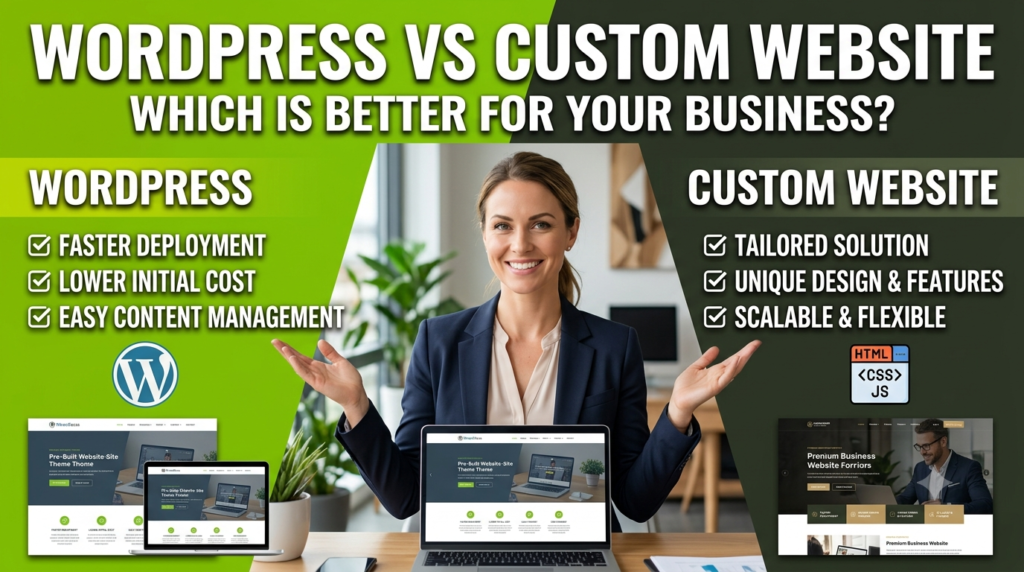
Choosing between WordPress and a custom website is one of the most important decisions a business makes before starting its online journey. Both options can create professional, responsive, and search-engine-friendly websites, but they differ significantly in terms of development cost, flexibility, scalability, maintenance, security, performance, and long-term business requirements.
A WordPress website can be an excellent choice for small businesses, startups, bloggers, educational institutions, service providers, and organizations looking for a practical website without a large initial investment. On the other hand, a custom website can provide greater control, unique functionality, advanced integrations, and a completely tailored digital experience.
We need to evaluate the business objective first rather than choosing a technology simply because it is popular. The right solution depends on what the website needs to accomplish today and how the business expects it to grow in the future.
What Is a WordPress Website?
WordPress is a popular content management system that allows businesses and individuals to create and manage websites without developing every component from scratch.
A WordPress website can be built using themes, plugins, page builders, custom code, and integrations. Businesses can use WordPress for corporate websites, blogs, portfolios, educational websites, service websites, news portals, membership websites, and even ecommerce stores.
One of the biggest advantages of WordPress is its extensive ecosystem. Thousands of themes and plugins are available for adding functionality such as:
- Contact forms
- SEO tools
- Ecommerce
- Payment gateways
- Booking systems
- Membership functionality
- Security features
- Analytics
- Social media integration
- Website caching
- Performance optimization
- Learning management systems
This makes WordPress particularly attractive when a business needs a professional website with commonly required functionality at a reasonable development cost.
What Is a Custom Website?
A custom website is developed specifically according to the requirements of a business or organization. Instead of relying primarily on pre-built themes and plugins, developers create the website’s design, functionality, database structure, and integrations around the project’s requirements.
A custom website can be designed from the ground up to support unique business processes.
For example, a company may require:
- A custom customer dashboard
- Advanced quotation systems
- Complex membership levels
- Custom reporting
- Enterprise-level integrations
- Proprietary booking systems
- Advanced calculators
- Custom APIs
- Complex databases
- Internal business automation
- Unique ecommerce workflows
When standard WordPress functionality cannot efficiently meet these requirements, custom development may be the better solution.
WordPress vs Custom Website: Key Differences
| Feature | WordPress Website | Custom Website |
|---|---|---|
| Initial Cost | Generally lower | Generally higher |
| Development Time | Faster | Usually longer |
| Design Flexibility | High with customization | Very high |
| Custom Functionality | Possible | Excellent |
| Plugins | Extensive ecosystem | Usually custom-built/integrated |
| Maintenance | Relatively straightforward | Depends on technology |
| Scalability | Good with proper architecture | Excellent when properly engineered |
| Content Management | Very easy | Can be customized |
| SEO | Excellent with proper setup | Excellent with proper development |
| Security | Requires regular updates | Depends on development quality |
| Unique Business Logic | Limited by architecture unless customized | Excellent |
| Long-Term Flexibility | High | Very high |
WordPress Website Cost vs Custom Website Cost
One of the most important differences between WordPress and custom development is the initial development cost.
A WordPress website generally costs less because developers can use an existing content management system, themes, plugins, frameworks, and reusable components. This reduces development time and makes it possible to launch a professional website relatively quickly.
A custom website generally requires more planning, UI/UX design, programming, database development, testing, and deployment. Consequently, the initial investment can be significantly higher. However, development cost should not be the only consideration.
A low-cost website that cannot support future requirements may eventually require redevelopment. Similarly, investing heavily in custom functionality that a business does not actually need can unnecessarily increase the project budget.
The better approach is to evaluate functionality, expected traffic, business processes, future expansion, maintenance requirements, and return on investment before selecting the technology.
WordPress vs Custom Website for Small Businesses
For most small businesses, WordPress can be an excellent starting point. A local business may need a website containing:
- Home page
- About Us
- Services
- Portfolio
- Blog
- Contact page
- Enquiry form
- Google Maps integration
- Social media links
- Testimonials
- SEO optimization
These requirements can generally be implemented efficiently using WordPress.
For example, a restaurant, coaching institute, consultancy, local service provider, real estate company, or professional freelancer may not need a completely custom-built platform.
A well-designed WordPress website can provide a professional appearance, responsive design, content management, SEO functionality, and scalable infrastructure without the complexity of developing everything from scratch.
When Should We Choose a Custom Website?
Custom development becomes more attractive when the website is expected to perform functions beyond a conventional business website. We may recommend a custom solution when a business requires specialized workflows that cannot be efficiently handled through standard WordPress plugins.
Examples include:
1. Complex Business Automation
If the website needs to automate complicated internal processes, a custom application can provide greater control over the workflow.
2. Advanced Customer Dashboards
Businesses requiring highly customized dashboards, account management, reporting, or role-based access may benefit from custom development.
3. Large-Scale Platforms
A website expecting substantial traffic, complex database operations, or thousands of concurrent users may require an architecture specifically designed around those requirements.
4. Unique Ecommerce Requirements
Standard ecommerce platforms are excellent for many businesses, but businesses with unusual pricing models, product configurations, subscription structures, logistics, or enterprise integrations may require custom functionality.
5. Proprietary Systems
If the website itself is part of the company’s competitive advantage, custom development can provide functionality specifically designed around the business model.
WordPress vs Custom Website for SEO
Both WordPress and custom websites can perform extremely well in search engines. WordPress does not automatically rank better than a custom website, and a custom website does not automatically outrank WordPress. Search performance depends on factors such as:
- Website architecture
- Page speed
- Mobile usability
- Content quality
- Keyword targeting
- Internal linking
- Technical SEO
- Structured data
- Crawlability
- Indexability
- Backlinks
- Search intent
- User experience
WordPress provides many tools that simplify SEO implementation. However, unnecessary plugins, poorly optimized themes, excessive scripts, duplicate content, weak hosting, and poor configuration can negatively affect performance.
A custom website provides greater technical control, but developers still need to implement SEO correctly.
Therefore, SEO capability should not be the deciding factor by itself when choosing WordPress vs custom development.
Website Performance: WordPress vs Custom Development
Performance depends heavily on how the website is built. A poorly optimized WordPress website can be slow because of:
- Too many plugins
- Unoptimized images
- Heavy themes
- Excessive JavaScript
- Poor hosting
- Unnecessary third-party scripts
- Incorrect caching configuration
However, a properly optimized WordPress website can deliver excellent performance. Custom websites can also be extremely fast because developers can control the architecture and include only the functionality that is required. But poor custom development can result in inefficient database queries, excessive code, poor caching, or badly optimized assets.
The important point is that technology alone does not determine website speed.
Website Security: WordPress vs Custom Website
Security is another important consideration. WordPress itself is widely used and has a mature security ecosystem. However, WordPress websites require regular updates for the core system, themes, and plugins. We should also implement:
- Strong administrator passwords
- Secure hosting
- SSL certificates
- Regular backups
- Security monitoring
- Updated software
- Limited administrator permissions
- Proper firewall configuration
- Secure forms and authentication
Custom websites are not automatically more secure. Security depends on the development practices, architecture, authentication system, server configuration, and ongoing maintenance.
A professionally developed and maintained website—whether WordPress or custom—should follow modern security practices.
Which Is Easier to Maintain?
WordPress generally provides an easier content management experience. Business owners and administrators can log into the WordPress dashboard and update:
- Pages
- Blog posts
- Images
- Menus
- Products
- Categories
- Basic website settings
This is particularly useful for businesses that frequently publish content.
Custom websites can also include powerful administration panels, but the level of convenience depends on how the system was developed. A custom CMS can be designed specifically for the business, although developing and maintaining such a system can require additional investment.
Scalability: Which One Is Better?
Both WordPress and custom websites can scale, but the appropriate choice depends on the nature of growth. A WordPress website can be scaled through:
- Better hosting
- Caching
- CDN implementation
- Database optimization
- Image optimization
- Code optimization
- Plugin management
- Server upgrades
For many small and medium-sized businesses, this is more than sufficient. A custom platform can be engineered around specific scalability requirements from the beginning. This becomes particularly useful for large applications, SaaS platforms, marketplaces, enterprise systems, and websites with highly specialized functionality.
WordPress vs Custom Website: Which One Should We Choose?
We can simplify the decision with a few practical scenarios.
Choose WordPress if:
- We need a business website quickly.
- We have a limited or moderate budget.
- We need an easy-to-use CMS.
- We require standard business functionality.
- We want to regularly publish blogs.
- We need strong SEO capabilities.
- We want access to a large plugin ecosystem.
- We expect normal business website traffic.
Choose Custom Development if:
- We require unique functionality.
- We need complex business automation.
- We require advanced dashboards.
- We need specialized database architecture.
- We require extensive API integrations.
- We are developing a large-scale platform.
- Our business model cannot be efficiently implemented using standard solutions.
- We need complete control over the application’s architecture.
Is WordPress Better Than a Custom Website?
There is no universal winner. WordPress is often better for businesses that need a cost-effective, flexible, content-driven website. It can reduce development time while providing access to a huge ecosystem of themes, plugins, integrations, and content management tools.
Custom development is often better for businesses that need specialized functionality, advanced automation, or complete control over their application architecture.
The best website is not necessarily the one built with the most advanced technology. It is the one that solves the business problem effectively while providing an appropriate balance between cost, performance, functionality, security, scalability, and maintainability.
WordPress vs Custom Website: Final Verdict
For a typical small or medium-sized business, WordPress is usually the practical choice. It allows businesses to launch a professional website without the development complexity and cost associated with building an entire platform from scratch.
For organizations with complex workflows, advanced applications, unique customer experiences, or specialized technical requirements, custom website development can provide significantly greater flexibility.
We should therefore begin with business requirements rather than technology preferences. A clear understanding of the website’s purpose, target audience, required features, budget, expected traffic, SEO strategy, and future expansion plans will make the decision much easier.
Whether we choose WordPress or custom development, the most important objective remains the same: build a fast, secure, mobile-friendly, user-focused website that supports measurable business growth.
Frequently Asked Questions
Is WordPress cheaper than a custom website?
Generally, yes. WordPress can be more affordable because developers can use an established CMS, themes, plugins, and reusable components. Custom development normally requires more design and programming work.
Is a custom website better for SEO?
Not necessarily. Both WordPress and custom websites can achieve strong SEO performance. Technical implementation, content, site structure, performance, mobile usability, and overall SEO strategy are more important than the platform alone.
Is WordPress suitable for business websites?
Yes. WordPress is suitable for many business websites, including corporate websites, local businesses, professional services, educational organizations, blogs, portfolios, and ecommerce websites.
Can a WordPress website be customized?
Yes. WordPress can be extensively customized using custom themes, child themes, custom plugins, PHP, JavaScript, CSS, APIs, and database modifications.
Can a custom website use a CMS?
Yes. A custom website can include a custom-built administration panel or integrate with an existing content management system depending on the project requirements.
Which is faster: WordPress or custom development?
Neither is automatically faster. A properly optimized website can be fast regardless of the platform. Custom development can provide greater control over performance, while optimized WordPress can also deliver excellent loading speeds.
Which option is better for a startup?
For many startups, WordPress can be a cost-effective way to establish an online presence quickly. If the startup’s core product requires a unique web application or complex functionality, custom development may be more appropriate.
Can we start with WordPress and move to a custom website later?
Yes, but migration should be planned carefully. URLs, SEO data, content, databases, user accounts, integrations, and functionality may need to be migrated or rebuilt.
How do we decide between WordPress and custom website development?
We should compare the required features, budget, timeline, expected traffic, maintenance requirements, scalability, integrations, security requirements, and long-term business objectives before making the decision.
What is the best choice for a local business?
For many local businesses, a professionally designed and SEO-optimized WordPress website provides an excellent combination of affordability, functionality, content management, and scalability. Custom development becomes more useful when the business requires specialized functionality that standard WordPress solutions cannot efficiently provide.