
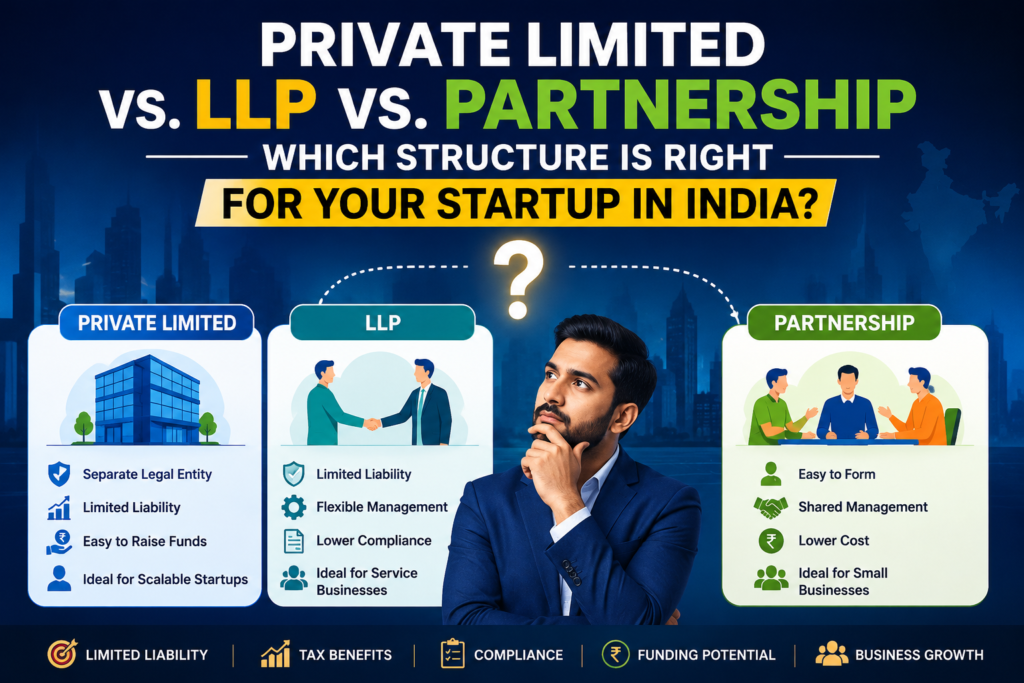
Starting a business in India requires more than a strong idea, a business plan, and initial funding. One of the most important decisions we make as entrepreneurs is choosing the right business structure. The legal structure we select influences our personal liability, taxation, compliance requirements, fundraising opportunities, ownership rights, and long-term growth potential.
Among the most popular business structures for startups in India are a Private Limited Company, Limited Liability Partnership (LLP), and Partnership Firm. Each structure serves different business needs. While a Private Limited Company is generally suitable for startups seeking investment and rapid expansion, an LLP can be an attractive option for professional services and businesses with multiple partners. A traditional partnership firm may work for small businesses that prioritise simplicity and shared management.
However, there is no single structure that is ideal for every entrepreneur. We need to evaluate our business objectives, financial resources, number of founders, risk exposure, and future plans before making a decision.
In this comprehensive guide, we compare Private Limited vs. LLP vs. Partnership in India, covering registration, liability, taxation, compliance, ownership, funding, advantages, disadvantages, and the factors that help us choose the most appropriate structure for our startup.
Understanding the Three Business Structures in India
Before comparing the three options, we should understand how each structure operates under Indian law.
1. Private Limited Company
A Private Limited Company is a separate legal entity incorporated under the Companies Act, 2013. It has its own legal identity, independent of its shareholders and directors.
A private company generally requires at least two shareholders and two directors, with at least one director meeting the applicable Indian residency requirement. A company can have a maximum of 200 members, subject to statutory rules and exceptions.
The ownership of a Private Limited Company is divided into shares. Shareholders own the company through their shareholding, while directors manage its operations in accordance with the law and the company’s governance arrangements.
This structure is particularly suitable for startups that intend to attract angel investors, venture capital, institutional funding, or strategic investors. It also supports employee stock option arrangements, subject to applicable legal requirements.
2. Limited Liability Partnership (LLP)
A Limited Liability Partnership combines certain characteristics of a traditional partnership with the benefit of limited liability. It is governed by the Limited Liability Partnership Act, 2008.
An LLP is a separate legal entity from its partners. It generally requires at least two partners and two designated partners, with at least one designated partner meeting the applicable Indian residency requirement.
Partners can define their respective rights, responsibilities, profit-sharing ratios, and management arrangements through an LLP agreement.
An LLP is often suitable for consulting firms, technology service providers, professional practices, agencies, and other businesses where the founders want operational flexibility without the full corporate governance framework of a company.
3. Traditional Partnership Firm
A traditional partnership firm is formed when two or more persons agree to share the profits of a business carried on by all or any of them acting for all. It is governed primarily by the Indian Partnership Act, 1932.
Partners usually define their capital contributions, responsibilities, profit-sharing arrangements, and other business terms through a partnership deed.
Unlike a Private Limited Company or LLP, a traditional partnership firm does not have the same separate legal personality and limited-liability protection. Partners generally have unlimited personal liability for the firm’s obligations, subject to applicable law.
Partnership firms may be suitable for small businesses operated by trusted partners who prefer a straightforward management structure. However, the liability exposure and difficulties associated with ownership transfers can become significant concerns as the business grows.
Private Limited vs. LLP vs. Partnership: Key Differences
The following table provides a quick comparison of the three structures.
| Feature | Private Limited Company | LLP | Partnership Firm |
|---|---|---|---|
| Governing legislation | Companies Act, 2013 | LLP Act, 2008 | Indian Partnership Act, 1932 |
| Minimum owners | 2 shareholders | 2 partners | 2 partners |
| Separate legal entity | Yes | Yes | Generally no |
| Limited liability | Generally limited to the unpaid amount on shares, subject to exceptions | Generally limited to agreed contribution, subject to exceptions | No general limited-liability protection |
| Registration | Mandatory incorporation | Mandatory incorporation | State registration generally optional, but strongly advisable |
| Ownership structure | Shares | Partnership interests under the LLP agreement | Partnership interests under the partnership deed |
| Management | Directors and corporate governance framework | Designated partners and partners | Partners |
| Annual compliance | Relatively extensive | Generally lower than a company | Generally simpler, subject to applicable requirements |
| Statutory audit | Required under applicable company law | Required when prescribed turnover or contribution thresholds are met | Depends on applicable tax and other legal requirements |
| Income tax | Generally taxed at applicable corporate rates | Generally taxed at applicable firm rates | Generally taxed at applicable firm rates |
| Equity investment | Well suited to equity fundraising | Less suited to conventional venture capital equity investment | Generally less suitable for institutional equity investment |
| Ownership transfer | Share transfers subject to law and restrictions | Governed by the LLP agreement and applicable law | Governed by the partnership deed and applicable law |
| Continuity | Perpetual succession | Perpetual succession | Subject to the partnership agreement and applicable law |
| Best suited for | Scalable, investment-oriented startups | Service businesses and closely held ventures | Small businesses with trusted partners |
Note: Actual legal, tax, and compliance obligations depend on the business’s circumstances and the laws in force.
1. Registration Process: Which Business Structure Is Easier to Start?
Registration is one of the first practical considerations when we establish a startup. The procedure, documentation, and ongoing administrative responsibilities differ across the three structures.
Private Limited Company Registration in India
A Private Limited Company is incorporated through the Ministry of Corporate Affairs (MCA).
The process generally involves obtaining the necessary digital signatures, selecting a compliant company name, preparing incorporation documents, and submitting the applicable forms through the MCA’s incorporation system.
The incorporation application typically includes the company’s proposed registered office details, information about directors and shareholders, and the memorandum and articles of association.
Depending on eligibility and the applicable process, incorporation is commonly completed through the integrated SPICe+ system.
After incorporation, we must establish the company’s statutory records, maintain accounting records, issue share certificates as required, and comply with applicable filing obligations.
Advantages of Private Limited Company registration:
- Creates a separate legal entity.
- Establishes a formal ownership structure through shares.
- Supports structured investment and ownership changes.
- Improves the clarity of responsibilities between shareholders and management.
- Provides a recognised framework for expansion and corporate transactions.
The main consideration is that incorporation is only the beginning. Companies must continue to meet their statutory obligations, including annual filings and other applicable corporate compliance requirements.
LLP Registration in India
An LLP is registered with the MCA under the LLP Act, 2008.
The registration process generally involves obtaining digital signatures where required, reserving or selecting an acceptable name, filing the incorporation application, and providing the necessary details of partners and designated partners.
After incorporation, the partners must execute and file the LLP agreement within the prescribed period, generally 30 days from incorporation.
The LLP agreement is an important document because it establishes the internal rules governing the business.
It can specify capital contributions, profit distribution, decision-making authority, admission of new partners, retirement, dispute resolution, and other operational matters.
Compared with a Private Limited Company, an LLP generally offers greater flexibility in internal management. Nevertheless, its statutory filings and accounting obligations must be completed on time.
Partnership Firm Registration in India
A traditional partnership is generally formed through a partnership agreement or deed. Registration is governed by the Indian Partnership Act, 1932, together with applicable state procedures.
Although registration of a partnership firm is generally optional under the central Partnership Act, an unregistered firm faces important restrictions under Section 69 concerning the enforcement of contractual rights through courts.
For this reason, registering the partnership is usually advisable.
A partnership deed should clearly describe the partners’ capital contributions, profit-sharing ratios, management responsibilities, remuneration, admission of new partners, retirement procedures, dispute resolution, and dissolution arrangements.
Depending on the state and the nature of the business, additional registrations may be necessary, including GST registration, local trade licences, and other applicable permissions.
Which structure is easiest to register?
A traditional partnership can be simpler to establish, particularly for a small business. An LLP offers a balance between formal legal protection and operational flexibility, while a Private Limited Company involves a more structured incorporation and governance framework.
We should compare the total cost of compliance and operation rather than considering registration cost alone.
2. Limited Liability: Which Structure Protects Personal Assets?
Liability protection is one of the most important differences between a Private Limited Company, an LLP, and a traditional partnership firm.
Personal Liability in a Private Limited Company
A Private Limited Company is legally separate from its shareholders. Generally, shareholders are liable only to the extent of any unpaid amount on the shares they hold.
This separation can help protect personal assets against ordinary business debts. However, limited liability is not absolute.
Personal guarantees, fraud, wrongful conduct, statutory violations, and other legally recognised circumstances can expose individuals to personal liability.
For example, if a startup takes a business loan and a founder provides a personal guarantee, the lender may pursue that founder personally in accordance with the guarantee’s terms.
Personal Liability in an LLP
An LLP also provides limited-liability protection. Generally, a partner is not personally liable merely because another partner has acted improperly or because the LLP has incurred a business debt.
However, a partner remains responsible for their own wrongful acts or omissions. Fraudulent conduct and personal guarantees may also create personal liability.
This structure can be attractive for service businesses where partners want to work together while separating ordinary business liabilities from personal assets.
Personal Liability in a Partnership Firm
Traditional partnership firms present greater personal financial risk.
Under partnership law, partners can be jointly and severally liable for acts of the firm carried out while they are partners. A partner’s personal assets may therefore be exposed to business liabilities, subject to applicable law.
For example, if a partnership firm cannot repay a supplier or lender, the partners may face personal claims for the firm’s obligations.
A partnership deed can allocate responsibilities between partners, but internal contractual arrangements do not automatically eliminate liability to third parties.
Our recommendation: If the business involves significant financial commitments, employees, borrowing, contractual risks, or the possibility of future expansion, we should carefully consider the limited-liability protection offered by a Private Limited Company or LLP.
3. Taxation: Private Limited vs. LLP vs. Partnership
Taxation can materially affect the profitability and cash flow of a startup. We should compare the applicable income tax rules, distributions to owners, deductions, and compliance costs before selecting a structure.
Taxation of a Private Limited Company
A domestic company is generally taxed under the corporate income tax provisions applicable to it. Eligible companies may qualify for concessional tax regimes, subject to the relevant conditions.
For eligible domestic companies opting for Section 115BAA of the Income-tax Act, 1961, the effective tax rate is generally 25.168%, including applicable surcharge and cess, assuming the prescribed conditions are satisfied.
The regime generally involves foregoing specified deductions and incentives.
Companies that do not opt for this regime may be taxed under other applicable provisions, depending on their turnover, income, and eligibility.
Dividends distributed to shareholders are generally taxable in the hands of the shareholders under the applicable provisions.
A startup must also consider tax deduction and collection obligations, GST where applicable, payroll-related compliance, and other statutory requirements.
Taxation of an LLP
An LLP is generally taxed as a firm under the applicable income tax provisions.
The standard income tax rate for a firm is generally 30%, with applicable surcharge and cess depending on the circumstances.
An LLP may also be eligible to claim deductions for qualifying partner remuneration and interest on capital, subject to the relevant statutory conditions and limits.
The tax treatment of profit distributions to partners differs from the dividend taxation framework applicable to companies. This can be relevant when founders intend to withdraw business profits regularly rather than reinvest them.
Taxation of a Partnership Firm
A traditional partnership firm is also generally taxed at the firm level at the applicable firm tax rate, commonly 30%, with surcharge and cess where applicable.
Qualifying partner remuneration and interest on capital may be deductible subject to statutory conditions.
Partners should understand the distinction between the firm’s taxable income, the amounts paid to partners, and the tax treatment of their individual receipts.
Which Structure Is More Tax-Efficient?
There is no universal answer.
An LLP may be attractive where founders intend to distribute profits among partners and prefer a flexible management arrangement. A Private Limited Company may be more appropriate when a substantial proportion of profits will be reinvested into product development, hiring, marketing, or expansion.
We should calculate the expected tax impact using realistic revenue, expenses, profits, remuneration, distributions, and reinvestment assumptions.
Tax rates and provisions can change through annual Finance Acts. Before incorporation, we should verify the rules applicable for the relevant financial year with a qualified tax professional.
4. Compliance Requirements: Which Structure Is Easier to Maintain?
Compliance obligations influence both administrative workload and the long-term cost of operating a business.
Private Limited Company Compliance
A Private Limited Company must comply with the Companies Act, 2013, and applicable MCA rules.
Common obligations include:
- Maintaining statutory registers and corporate records.
- Holding board meetings and shareholder meetings as applicable.
- Preparing financial statements.
- Conducting statutory audits, regardless of turnover, subject to limited statutory exceptions.
- Filing annual financial statements and annual returns with the MCA.
- Filing income tax returns.
- Complying with applicable GST, payroll, and other regulatory requirements.
Additional requirements may apply depending on the company’s size, activities, transactions, and ownership.
Although these obligations require time and money, they create a formal governance structure that can be valuable when working with investors, lenders, and large clients.
LLP Compliance
LLPs generally have a lighter compliance framework than companies, although they remain subject to important filing and accounting requirements.
Common obligations include:
- Filing the annual return in Form 11.
- Filing the Statement of Account and Solvency in Form 8.
- Filing the applicable income tax return.
- Maintaining books of account.
- Conducting a statutory audit when the applicable turnover or contribution threshold is met.
Under the LLP Rules, an audit is generally required if turnover exceeds ₹40 lakh or contribution exceeds ₹25 lakh, subject to the applicable rules and exceptions.
An LLP must also report changes in partners, designated partners, registered office details, and other relevant information where required.
Partnership Firm Compliance
A traditional partnership firm usually has fewer central corporate filing requirements than a company or LLP.
However, it must maintain proper financial records and comply with applicable tax, GST, employment, licensing, and other business regulations.
A tax audit may be required when the applicable statutory conditions and thresholds are met.
State-specific registration requirements and sector-specific regulations must also be considered.
Best choice for lower ongoing compliance: An LLP may offer a practical middle ground for founders seeking limited liability without the full company-law compliance framework. A traditional partnership may be administratively simpler, but its personal liability exposure must be carefully weighed against the savings.
5. Fundraising and Investment: Which Structure Is Best for Startups?
Our long-term funding strategy should strongly influence the legal structure we choose.
Private Limited Company for Venture Capital and Angel Investment
A Private Limited Company is generally the preferred structure for startups seeking conventional equity investment from angel investors, venture capital funds, and institutional investors.
Investors can subscribe to shares in exchange for ownership. The company can also issue different classes of shares where legally permitted and structured appropriately.
A formal shareholding structure helps founders document ownership percentages, investment terms, shareholder rights, and future dilution.
Private companies may also establish employee stock option plans, subject to applicable legal requirements, enabling them to attract and retain skilled employees.
For example, a technology startup developing a software platform may initially have two founders. If it later raises capital from an angel investor and then a venture capital fund, a Private Limited Company can provide a familiar structure for these transactions.
Investors will still conduct due diligence and negotiate investment documents. Incorporation alone does not guarantee funding.
LLP for Self-Funded and Partner-Led Businesses
An LLP can be suitable when founders primarily rely on their own savings, business revenue, or conventional borrowing.
It is often appropriate for consulting firms, marketing agencies, software development companies, and professional service providers.
However, conventional venture capital investment can be more difficult because investors typically expect shares and a corporate equity structure. LLP ownership and profit-sharing arrangements operate differently.
Although investment and financing alternatives may exist, they require careful structuring and may not suit every investor.
Partnership Firm for Small, Closely Held Businesses
Traditional partnerships are generally less attractive for institutional equity investment.
The absence of the same corporate ownership framework, combined with partners’ personal liability, can make the structure less suitable for businesses seeking substantial outside capital.
It may still work for a small enterprise funded by its partners, provided everyone understands the legal and financial risks.
Our recommendation: If we expect to raise angel investment, venture capital, or multiple rounds of equity funding, a Private Limited Company is generally the most practical starting point.
6. Ownership and Management: How Much Flexibility Do Founders Need?
Ownership and management determine how founders make decisions, share profits, resolve disagreements, and admit new owners.
Ownership in a Private Limited Company
A Private Limited Company separates ownership from day-to-day management.
Shareholders own shares, while directors oversee the company’s management within the framework of applicable law and corporate documents.
Share transfers are subject to the Companies Act, the company’s articles of association, and any applicable contractual restrictions.
This structure is useful when founders need clearly documented ownership percentages or anticipate bringing in new shareholders.
However, founders should establish a shareholders’ agreement and appropriate corporate documentation where necessary to clarify voting rights, reserved matters, transfer restrictions, exit arrangements, and dispute resolution.
Ownership in an LLP
An LLP offers flexibility through its LLP agreement.
Partners can define profit-sharing ratios separately from capital contributions, where agreed and legally permissible. They can also establish different responsibilities, decision-making rules, and procedures for admitting or removing partners.
This flexibility can be especially useful for professional service businesses in which partners contribute different amounts of capital, expertise, or client relationships.
The agreement should address retirement, death, incapacity, disputes, valuation of partnership interests, and the procedure for transferring economic rights.
Ownership in a Partnership Firm
A traditional partnership also allows substantial contractual flexibility through its partnership deed.
Partners can agree on capital contributions, profit-sharing ratios, remuneration, and management responsibilities.
Nevertheless, ownership changes may be more complicated when a partner retires, dies, becomes insolvent, or wishes to exit. The consequences depend on the partnership agreement and applicable law.
A carefully drafted deed is essential to reduce disagreements.
7. Business Continuity and Long-Term Growth
A startup’s legal structure should support its ability to continue operating despite changes in ownership or management.
Private Limited Company: Perpetual Succession
A company generally continues to exist independently of changes in its shareholders or directors.
This feature helps maintain continuity when founders leave, investors join, or ownership changes.
It can also support mergers, acquisitions, strategic partnerships, and other corporate transactions, subject to applicable law.
LLP: Continuity Through a Separate Legal Identity
An LLP has a separate legal identity and perpetual succession.
Changes in partners do not automatically terminate the LLP. The agreement and applicable legal requirements govern how new partners are admitted and existing partners leave.
This structure can support businesses that intend to operate for the long term without needing a conventional share-based corporate structure.
Partnership Firm: Continuity Depends on the Arrangement
The continuity of a traditional partnership depends on the partnership deed and applicable law.
Changes in partners can affect the firm’s constitution, and dissolution may arise in certain circumstances unless the arrangement and law provide otherwise.
Founders should consider whether the business must continue seamlessly after a partner retires, dies, or exits.
8. Advantages and Disadvantages of a Private Limited Company
A Private Limited Company offers several advantages for ambitious startups, but it also involves responsibilities.
Advantages
- Limited liability: Shareholders generally have limited liability for company debts.
- Separate legal identity: The company can own assets and enter contracts in its own name.
- Investment opportunities: The share structure supports conventional equity fundraising.
- Scalability: The structure is suitable for expansion into new markets and business lines.
- Ownership flexibility: Shares can be transferred in accordance with applicable law and restrictions.
- Business credibility: Formal governance may help when engaging with institutional investors and larger organisations.
- Employee incentives: Eligible companies can establish share-based employee incentive plans.
Disadvantages
- More extensive compliance requirements.
- Mandatory statutory audit requirements under company law.
- Additional accounting and professional service costs.
- Formal procedures for certain management and ownership decisions.
- Potential complexity when issuing shares or restructuring ownership.
A Private Limited Company is generally most suitable when the expected benefits of investment readiness, governance, and scalability justify the additional compliance costs.
9. Advantages and Disadvantages of an LLP
An LLP combines limited liability with contractual flexibility.
Advantages
- Limited liability: Partners generally have protection from ordinary business liabilities.
- Separate legal identity: The LLP can hold assets and enter contracts independently.
- Flexible management: The LLP agreement can allocate responsibilities and profits.
- Lower compliance burden: Generally fewer corporate governance obligations than a Private Limited Company.
- Suitable for professional services: Works well for agencies, consulting firms, and partner-led businesses.
- Perpetual succession: The LLP can continue despite changes in partners.
Disadvantages
- Less suitable for conventional venture capital equity funding.
- Statutory filings remain mandatory.
- An LLP agreement requires careful drafting.
- Adding or removing partners may require contractual and regulatory procedures.
- Certain investors and counterparties may prefer a corporate shareholding structure.
An LLP is particularly attractive for businesses focused on service delivery, sustainable profitability, and partner participation rather than rapid equity-funded expansion.
10. Advantages and Disadvantages of a Partnership Firm
A traditional partnership may suit entrepreneurs who want a simple arrangement for running a small business together.
Advantages
- Relatively simple formation.
- Flexible management and profit-sharing arrangements.
- Fewer central corporate compliance requirements.
- Direct participation of partners in business operations.
- Suitable for certain small, closely held businesses.
Disadvantages
- Unlimited personal liability for partners in ordinary circumstances.
- Restrictions affecting unregistered firms’ ability to enforce contractual rights through courts.
- Less convenient for institutional fundraising.
- Potential disagreements over authority, profits, and responsibilities.
- Ownership changes can affect continuity.
- Greater need to rely on contractual arrangements between partners.
A partnership firm should not be selected solely because it appears inexpensive to establish. We must also consider the potential cost of disputes, unpaid business debts, and personal liability.
11. Which Structure Is Best for Different Types of Startups?
The most appropriate structure depends on the business model, risk exposure, growth strategy, and ownership preferences.
| Business type | Structure to consider | Main reason |
|---|---|---|
| Technology startup seeking venture capital | Private Limited Company | Familiar share-based investment structure |
| SaaS business planning rapid expansion | Private Limited Company | Supports equity fundraising and structured ownership |
| Digital marketing agency | LLP or Private Limited Company | Depends on investment plans and growth ambitions |
| Website development agency | LLP or Private Limited Company | Balances liability protection with business objectives |
| Consulting firm with multiple partners | LLP | Flexible partner-led management |
| Professional services business | LLP, subject to sector rules | Separate legal identity and contractual flexibility |
| Small family business | LLP or Partnership Firm | Depends on liability tolerance and operational needs |
| Local trading business | LLP, Private Limited Company, or Partnership Firm | Depends on risk, scale, and ownership requirements |
| Startup planning institutional investment | Private Limited Company | Generally more compatible with investor expectations |
| Small business run by trusted partners | Partnership Firm or LLP | Depends on personal liability exposure and desired protection |
These are general guidelines, not absolute rules. Licensing conditions, professional regulations, investor requirements, and the nature of the business may influence the final choice.
12. Private Limited vs. LLP: A Detailed Comparison for Growing Businesses
Many entrepreneurs narrow their decision to a Private Limited Company or an LLP because both provide a separate legal identity and limited-liability protection.
The difference often comes down to how the founders want to finance, manage, and expand the business.
A Private Limited Company is usually the stronger option when the founders intend to build a scalable enterprise with external investors, share-based ownership, and formal governance.
An LLP is often more practical when the business generates revenue through services, the founders want to distribute profits, and outside equity investment is not a central objective.
For example, a digital agency with three partners may prefer an LLP if each partner contributes expertise and shares profits under a negotiated agreement. If the same founders intend to develop a technology product, raise venture capital, issue employee stock options, and expand internationally, a Private Limited Company may provide a more suitable long-term framework.
We should also evaluate the cost of changing structures later. Converting an existing entity can involve tax, contractual, regulatory, and operational considerations. Selecting a suitable structure at the outset can reduce future disruption.
13. Can We Convert a Partnership Firm or LLP Into a Private Limited Company?
Yes, certain business structures can be converted into a company through legally prescribed procedures, subject to eligibility and applicable requirements.
An eligible partnership firm may be converted into a company under the relevant provisions of the Companies Act, 2013. An LLP may also be converted into a company where the applicable statutory framework permits it and the conditions are satisfied.
The process can involve partner approvals, incorporation documentation, creditor considerations, asset and liability arrangements, and other formalities.
Conversion should not be treated as a purely administrative name change. It can affect contracts, licences, tax positions, ownership arrangements, and existing liabilities.
For businesses considering conversion, we should review:
- The current ownership structure.
- Existing loans and contractual obligations.
- Tax consequences.
- Eligibility under the applicable law.
- Treatment of assets and liabilities.
- Required approvals and regulatory filings.
- Future investment plans.
Professional legal and tax advice is recommended before beginning the conversion process.
14. Cost of Registering a Private Limited Company, LLP, and Partnership Firm in India
The cost of starting a business varies depending on the structure, state, professional assistance, capital arrangements, documentation, and ongoing compliance requirements.
Private Limited Company Cost
Potential costs include digital signatures, applicable government filing charges, stamp duty, professional incorporation fees, accounting, annual filings, and statutory audit services.
The total cost of ownership should also account for the time required to maintain corporate records and complete recurring compliance.
LLP Registration Cost
LLP costs may include digital signatures, name-related filings where applicable, incorporation charges, stamp duty on the LLP agreement, professional fees, accounting, annual filings, and audit costs when required.
The actual amount depends on contribution, state-specific stamp duty, and professional service arrangements.
Partnership Firm Registration Cost
Partnership costs may include drafting the partnership deed, stamp duty, registration charges where applicable, professional fees, and business-specific licences.
Even when initial formation costs are low, the partners should budget for bookkeeping, tax filings, GST compliance where applicable, and other business expenses.
Which Structure Is the Cheapest?
A traditional partnership may be the least expensive to establish, while an LLP can offer a balance between limited liability and compliance costs. A Private Limited Company generally involves more extensive ongoing formalities.
However, the cheapest structure is not necessarily the most economical over the life of the business. We should consider the potential cost of liability, disputes, restructuring, and fundraising limitations.
For accurate estimates, we should obtain a current quotation that separates government fees, professional fees, taxes, and annual maintenance costs.
15. Common Mistakes to Avoid When Choosing a Business Structure
Selecting the wrong structure can create unnecessary expenses and complications as the business grows. We can avoid several common mistakes by evaluating the decision carefully.
Choosing Only on the Basis of Registration Cost
Low initial expenses may appear attractive, but we should also consider annual compliance, liability, and future restructuring.
Ignoring Personal Liability
Founders sometimes focus on revenue and profitability without assessing the risks associated with loans, employees, suppliers, customer claims, and contractual obligations.
A traditional partnership can expose personal assets to business liabilities.
Choosing an LLP Despite Plans for Venture Capital
An LLP may be appropriate for a profitable service business, but a startup expecting conventional equity investment should evaluate a Private Limited Company from the beginning.
Using an Incomplete Partnership Deed or LLP Agreement
Poorly drafted agreements can cause disputes over profit-sharing, capital contributions, management authority, exits, and decision-making.
We should clearly document the commercial expectations of every founder.
Ignoring Future Ownership Changes
A business may begin with two founders but later need investors, senior employees, or strategic partners.
The legal structure should accommodate realistic future requirements.
Overlooking Sector-Specific Regulations
Some businesses require licences or approvals regardless of their legal structure. Financial services, healthcare, education, food, and other regulated sectors may have additional requirements.
Choosing a company or LLP does not automatically satisfy every sector-specific rule.
16. Step-by-Step Guide to Choosing the Right Business Structure
We can make the decision easier by following a structured process.
Step 1: Define our business goals. Determine whether we want to build a small owner-managed business, a profitable professional services firm, or a scalable startup seeking outside investment.
Step 2: Evaluate liability exposure. Consider borrowing, contractual commitments, operational risks, employees, and potential claims.
Step 3: Identify our funding strategy. Decide whether the business will rely on founders’ capital, operating revenue, loans, angel investors, or venture capital.
Step 4: Compare compliance costs. Estimate incorporation costs, annual filings, accounting expenses, audits, and professional fees.
Step 5: Determine how ownership will work. Establish capital contributions, profit-sharing ratios, voting rights, and procedures for admitting or removing owners.
Step 6: Consider taxation. Compare the applicable tax treatment of the business, owner remuneration, and profit distributions using realistic financial projections.
Step 7: Plan for future growth. Evaluate whether the structure can support additional founders, investors, employees, new business locations, and future transactions.
Step 8: Obtain professional advice. Consult a qualified company secretary, chartered accountant, or lawyer where necessary to verify eligibility, statutory requirements, and tax implications.
17. Frequently Asked Questions (FAQs)
Is a Private Limited Company better than an LLP in India?
A Private Limited Company is generally more suitable for startups seeking equity investment, venture capital, employee stock options, and rapid expansion. An LLP may be better for service-based businesses and professional firms that want limited liability with flexible internal management and comparatively lower compliance requirements.
Which is better for a startup: LLP or Partnership Firm?
An LLP generally provides stronger protection for partners’ personal assets because it is a separate legal entity with limited-liability provisions. A traditional partnership may be simpler to establish, but partners generally face unlimited personal liability for firm obligations. The right choice depends on the business’s risks, finances, and objectives.
Can a single person start a Private Limited Company in India?
A regular Private Limited Company generally requires at least two shareholders and two directors. A single entrepreneur may consider a One Person Company (OPC), subject to the applicable eligibility and statutory requirements, or another suitable business structure.
Is LLP registration mandatory in India?
An LLP must be incorporated with the Ministry of Corporate Affairs to obtain LLP status. A traditional partnership firm operates under a different legal framework, and its registration is generally optional under the central Partnership Act, although registration is strongly advisable because of the legal restrictions applicable to unregistered firms.
Which structure has the lowest compliance requirements?
A traditional partnership generally has fewer central corporate filing requirements than a company or LLP. However, applicable tax, GST, licensing, and other statutory obligations remain relevant. An LLP can be a useful compromise between limited liability and compliance workload.
Can an LLP raise investment?
An LLP can obtain funding through suitable arrangements, subject to applicable law and contractual terms. However, it does not offer the same conventional share-based ownership structure as a Private Limited Company, which is why many institutional equity investors prefer companies.
Which business structure is best for a digital marketing agency?
An LLP may be appropriate for a digital marketing agency operated by a small group of partners who share responsibilities and profits. A Private Limited Company may be more suitable if the agency plans to raise equity investment, develop scalable technology products, or expand through a structured corporate ownership model.
Which structure is best for a small business in India?
A small business should compare liability protection, operational complexity, taxes, ownership arrangements, and growth plans. A partnership may suit some closely held businesses, while an LLP or Private Limited Company may be preferable where limited liability and continuity are important.
Can we change our business structure later?
In certain circumstances, a partnership firm or LLP can be converted into a company through prescribed legal procedures. Conversion may involve tax consequences, documentation, approvals, and changes to contracts or registrations. It is best to evaluate the long-term implications before selecting a structure.
Does a Private Limited Company pay more tax than an LLP?
Not necessarily. The actual tax burden depends on the applicable tax regime, taxable income, deductions, surcharge, cess, and the way profits are distributed or reinvested. A comparison should use the business’s actual financial projections rather than headline rates alone.
Conclusion: Which Structure Should We Choose for Our Startup in India?
Choosing between a Private Limited Company, LLP, and Partnership Firm is a strategic decision that affects our startup’s ownership, financial risk, tax position, compliance obligations, and ability to grow.
A Private Limited Company is generally the preferred choice for founders who want to build a scalable business, attract angel investors or venture capital, issue shares, and establish a formal corporate governance structure.
An LLP is often a practical choice for professional service providers, consulting businesses, digital agencies, and partner-led ventures that need limited-liability protection and flexible management without the full compliance framework of a company.
A Partnership Firm may work for small businesses operated by trusted partners who prefer a straightforward arrangement. However, the risk of unlimited personal liability and the restrictions affecting unregistered firms should be considered carefully.
Before making the final decision, we should evaluate our business model, funding requirements, anticipated profits, liability exposure, ownership arrangements, and long-term growth plans. We should also confirm the current legal and tax requirements with qualified professionals.
Ultimately, the right business structure is the one that supports our present operations while providing a practical foundation for future growth.