Building an e-commerce website is one of the most effective ways for businesses in India to reach more customers, sell products online, and establish a strong digital presence. Whether we operate a small retail shop, a startup, a clothing brand, a wholesale business, or an established company, an online store can help us expand beyond geographical boundaries and generate sales around the clock.
However, one of the first questions we need to answer before launching an online store is: How much does e-commerce website development cost in India in 2026–27?
The cost depends on several factors, including the number of products, website design, e-commerce platform, payment gateway integration, shipping functionality, inventory management, security, and custom features. A basic online store can be relatively affordable, while a sophisticated e-commerce platform with advanced automation and custom integrations requires a larger investment.
In this comprehensive guide, we explain e-commerce website development costs in India for 2026–27, compare popular platforms, examine essential features, and identify the expenses businesses should consider before investing in an online store.
Our objective is to help businesses choose the right e-commerce solution based on their budget, operational requirements, and long-term growth plans.
E-commerce Website Development Cost Calculator
E-Commerce Cost Estimator Interactive 2026
Configure your online store requirements below to get an instant realistic cost estimate & project timeline breakdown.
1 Platform & Tech Stack
Choose the foundational framework for your online store.
2 Catalog Size & Scale
Select expected number of product SKUs to calculate catalog configuration effort.
3 Features & Integrations
Select custom capabilities and third-party integrations required.
Tailor-made Figma design system instead of pre-built themes.
Integration of Stripe, Razorpay, PhonePe, or PayPal setup.
Real-time rate calculation & automated dispatch (Shiprocket, FedEx).
Two-way automatic sync with warehouse software or SAP/Zoho.
Auto-geo detection, multi-currency display, and language translation.
Customer point accumulation, cashback, and referral link engines.
Automated recovery sequences via Email & WhatsApp APIs.
Interactive product personalization tool or 3D view model.
Advanced schema markup, image webp conversion & 90+ PageSpeed setup.
Companion Hybrid/Flutter App ready for App Store & Google Play.
4 Ongoing Support & Maintenance
Choose ongoing technical maintenance and security coverage.
E-commerce Website Development Cost in India (2026–27)
The cost of developing an e-commerce website in India can range from approximately ₹15,000 for a basic catalogue-style website with limited selling functionality to several lakhs of rupees for a fully customised online shopping platform.
The following figures are indicative planning estimates, not fixed market prices. Actual quotations depend on the developer, project scope, platform, design complexity, and features required.
| Type of E-commerce Website | Estimated Development Cost |
|---|---|
| Basic product catalogue website | ₹15,000–₹30,000 |
| Small business online store | ₹25,000–₹60,000 |
| Standard e-commerce website | ₹50,000–₹1,20,000 |
| Growing business online store | ₹1,00,000–₹3,00,000 |
| Custom e-commerce website | ₹2,00,000–₹8,00,000+ |
| Enterprise e-commerce platform | ₹8,00,000–₹25,00,000+ |
| Multi-vendor marketplace | ₹3,00,000–₹15,00,000+ |
These estimates may overlap because two projects with similar product counts can have very different technical requirements.
For example, a small business selling 50 products with a standard checkout process may need a relatively straightforward website. Another business selling the same number of products might require product personalisation, multiple shipping rules, customer accounts, automated invoicing, and integration with an existing inventory system.
The most cost-effective approach is to select features according to business needs rather than paying for functionality that we may never use.
1. What Determines E-commerce Website Development Cost in India?
Understanding the major cost components helps us prepare a realistic budget and avoid unexpected expenses after the website goes live.
Website Design and User Experience
Website design influences how customers perceive a brand and navigate the online store. A professionally designed website should make it easy for visitors to find products, compare options, add items to their shopping carts, and complete purchases.
A ready-made theme with basic customisation is generally more affordable than a fully customised design. Businesses with distinctive branding, complex product categories, advanced filtering, or specialised shopping experiences may require additional design and development work.
Typical estimated costs include:
- Basic theme installation and customisation: ₹5,000–₹15,000
- Professional storefront design: ₹15,000–₹40,000
- Custom user interface and user experience design: ₹40,000–₹1,00,000+
The actual cost depends on the number of page templates, design revisions, mobile layouts, and interactive elements required.
Number of Products and Product Categories
Product catalogue size directly affects the time needed to prepare an online store. Each product may require a title, description, price, images, stock information, category assignment, and search-engine optimisation details.
A store selling 20 products is usually simpler to configure than one selling 2,000 products with multiple sizes, colours, specifications, and stock variations.
We should also distinguish between building the product management system and entering product information. A developer may configure the store while the business owner supplies product data, or the quotation may include catalogue entry as a separate service.
Payment Gateway Integration
An Indian e-commerce website should offer convenient and reliable payment methods. Depending on the payment provider and business requirements, these may include:
- UPI payments
- Credit and debit cards
- Net banking
- Digital wallets
- Cash on Delivery (COD)
- EMI or other supported payment options
Payment gateway integration may cost approximately ₹3,000–₹10,000 as a planning estimate for a straightforward setup, although it may be included in the overall development package.
Payment processing charges are separate from website development costs. Gateway fees depend on the provider, payment method, merchant agreement, and applicable taxes. Businesses should verify current charges directly with their chosen payment provider.
Shipping and Delivery Integration
Shipping functionality allows customers to receive their purchases without complicated manual coordination. Depending on the business model, the website may need courier integration, automatic shipping calculations, tracking numbers, delivery notifications, and return management.
A small business serving a limited area may only need basic shipping rules. A nationwide retailer with multiple warehouses may require automated courier selection and inventory-based fulfilment.
Basic shipping configuration may be included in a standard development package, while advanced integrations can increase the project cost.
Mobile Responsiveness
A large proportion of online shopping takes place on smartphones. Therefore, an e-commerce website must provide a smooth mobile experience.
Responsive design ensures that product images, navigation menus, prices, checkout forms, and payment buttons display correctly on different screen sizes.
We should prioritise readable text, fast-loading product pages, simple checkout steps, and clearly visible calls to action. Mobile responsiveness should be considered a standard requirement rather than an optional premium feature.
2. E-commerce Website Development Cost by Platform
Choosing the right platform can significantly influence both the initial development budget and long-term operating expenses.
The following estimates are indicative project budgets for India in 2026–27, not official platform prices.
WooCommerce Website Development Cost
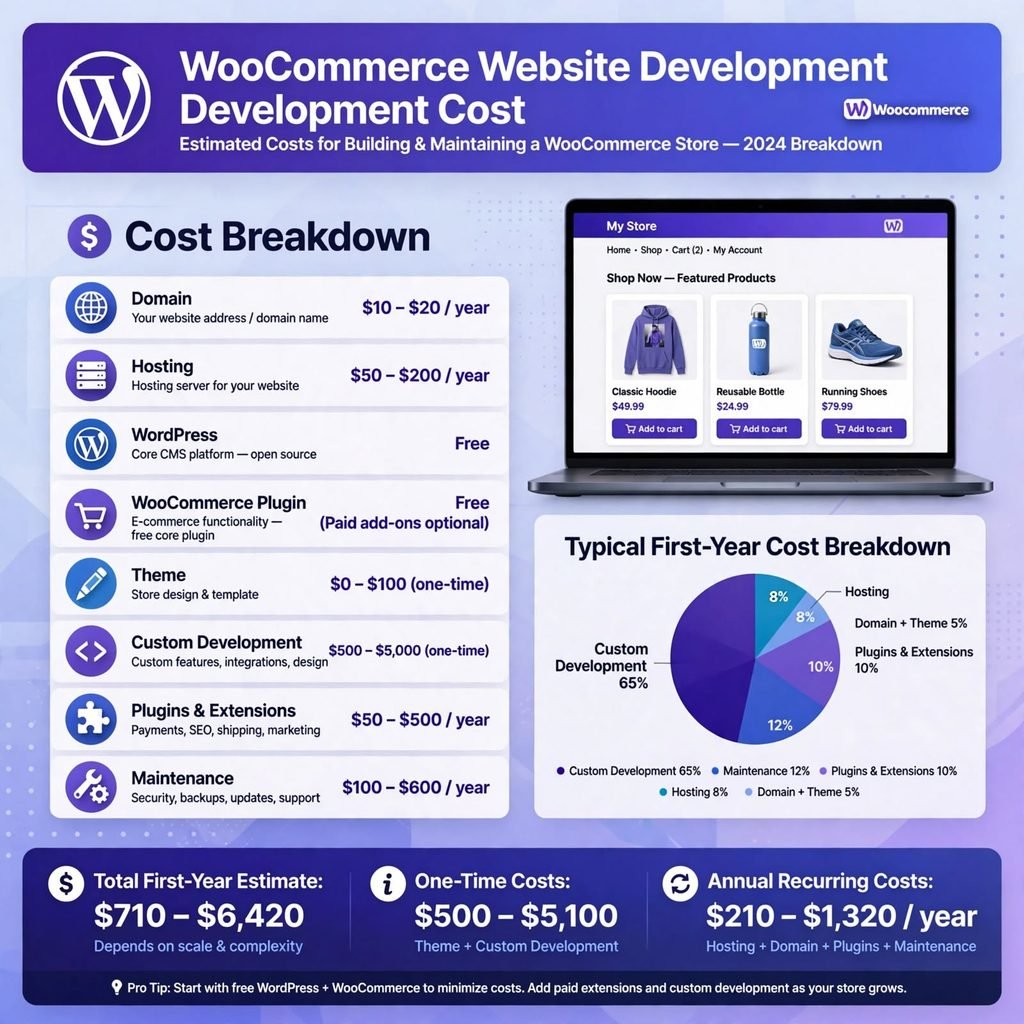
WooCommerce is an open-source e-commerce platform that works with WordPress. It is suitable for small businesses, growing brands, wholesalers, and companies that want flexibility over their website design and content.
The core WooCommerce software is free, but businesses need to account for hosting, domain registration, paid extensions where required, development, security, and ongoing maintenance. WooCommerce
| Expense | Estimated Cost |
|---|---|
| Initial website development | ₹25,000–₹1,50,000+ |
| Domain registration | ₹800–₹2,000/year |
| Hosting | ₹4,000–₹30,000+/year |
| Premium themes and plugins | ₹0–₹25,000+/year |
| Maintenance and updates | ₹2,000–₹10,000/month |
These costs vary with hosting capacity, licence requirements, and the level of professional support.
Best for: Businesses that want ownership and flexibility, content-driven stores, local retailers, and companies planning to expand their online presence gradually.
Shopify Website Development Cost
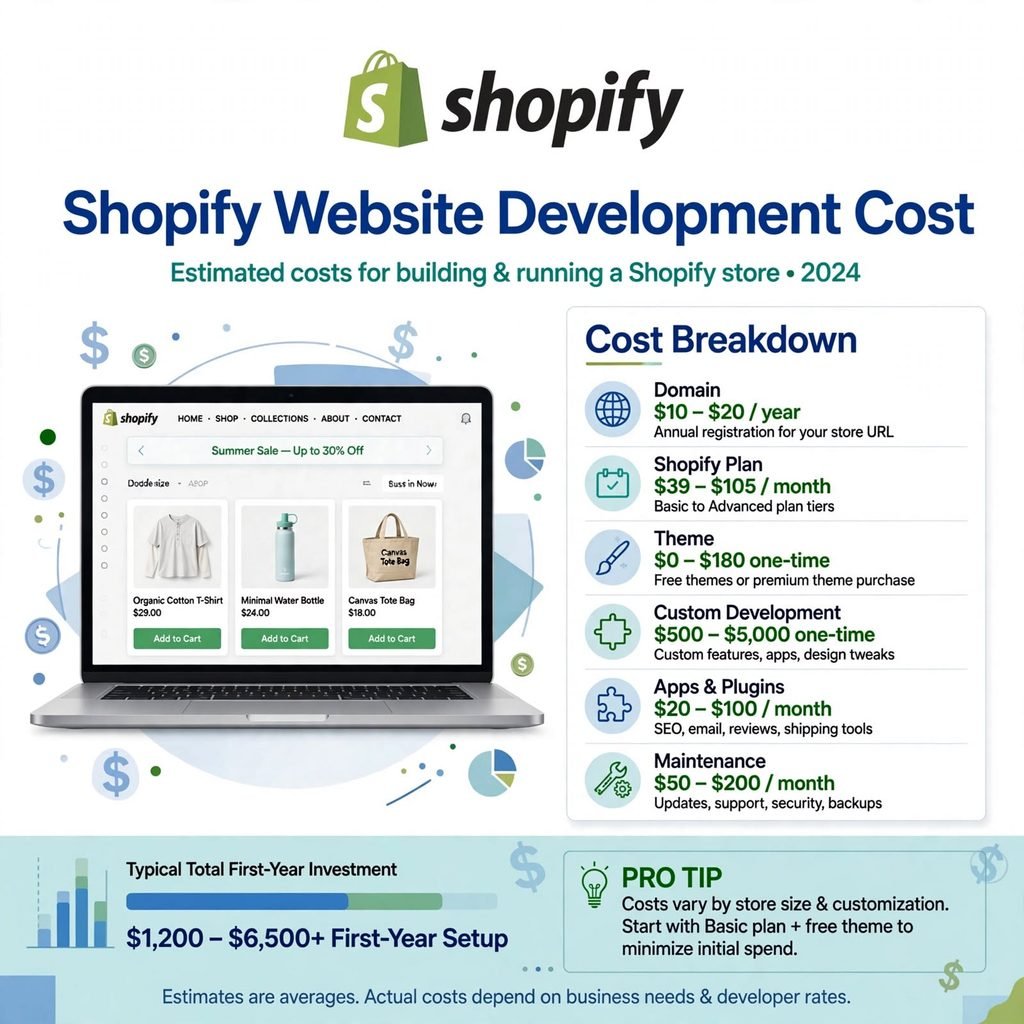
Shopify is a hosted e-commerce platform that provides store-building tools, product management, hosting, and integrated commerce features. It is particularly useful for businesses that prefer a managed platform rather than maintaining their own server infrastructure.
Shopify’s published Indian pricing currently lists the Basic plan at ₹1,499 per month when billed yearly, with higher-priced plans available for growing teams and more advanced requirements. These prices may change, so businesses should check the official Shopify India pricing page. Shopify India
| Expense | Estimated Cost |
|---|---|
| Professional store setup | ₹20,000–₹75,000+ |
| Basic plan | ₹17,988/year at the listed annual-billing rate |
| Paid apps and additional tools | Depends on selection |
| Custom theme development | Additional cost |
| Payment processing | Based on provider and applicable fees |
Shopify’s subscription is not the complete cost of running a store. Paid applications, customisation, payment processing, and optional services can increase the total.
Best for: Entrepreneurs seeking a managed platform, direct-to-consumer brands, and businesses that want to launch quickly without managing their own hosting environment.
Custom E-commerce Website Development Cost
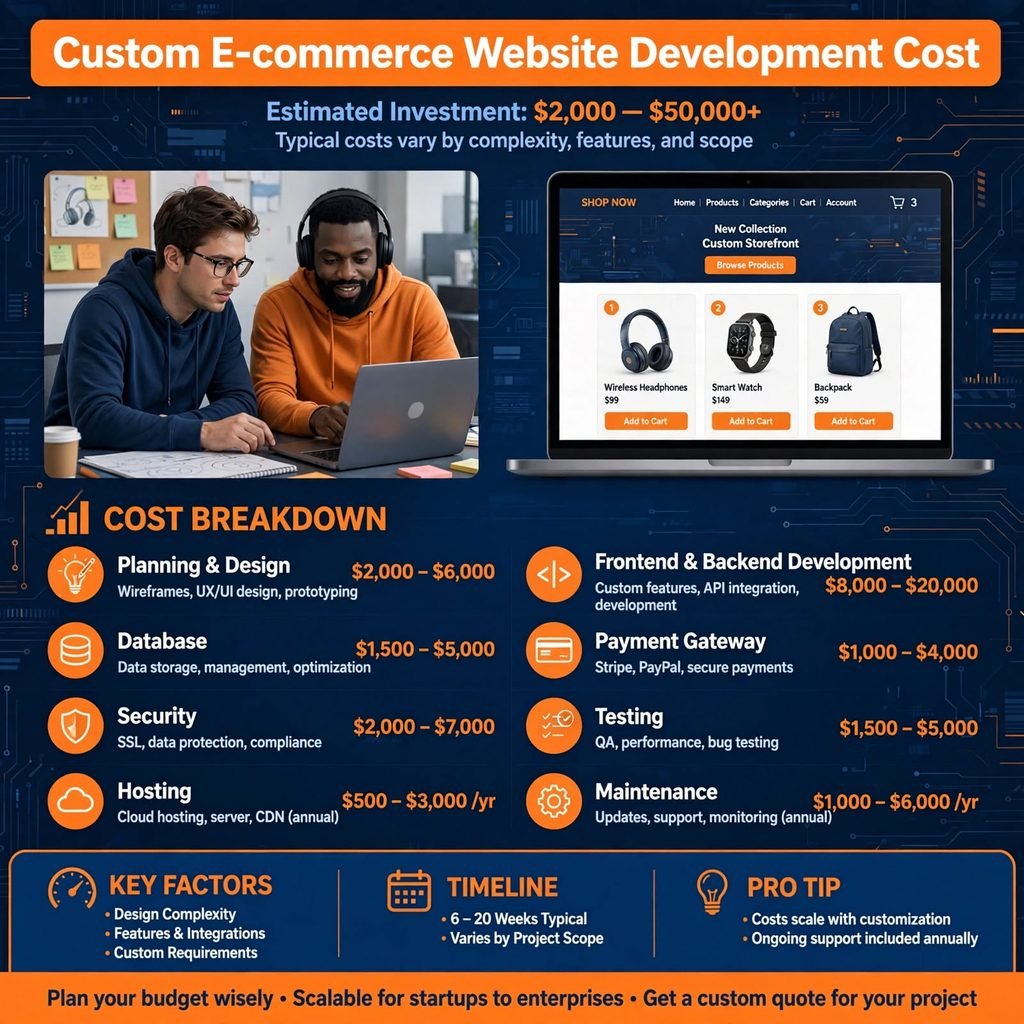
Custom e-commerce development is suitable when standard platforms cannot adequately support a company’s operational requirements.
Examples include specialised wholesale pricing, complex product configurators, multi-warehouse inventory, custom subscription rules, or integrations with enterprise resource planning systems.
| Project Type | Estimated Development Cost |
|---|---|
| Small custom online store | ₹1,50,000–₹3,00,000 |
| Advanced e-commerce platform | ₹3,00,000–₹8,00,000 |
| Enterprise-level solution | ₹8,00,000–₹25,00,000+ |
Custom solutions require careful planning, development, testing, and ongoing technical support. The business may also need to budget for cloud infrastructure, monitoring, backups, security updates, and future feature development.
Best for: Established businesses with specialised workflows, complex integrations, or requirements that cannot be handled efficiently by standard e-commerce tools.
WooCommerce vs Shopify vs Custom Development
| Factor | WooCommerce | Shopify | Custom Development |
|---|---|---|---|
| Initial investment | Low to high | Low to high | High |
| Hosting management | Business or developer manages it | Included | Depends on architecture |
| Customisation | Extensive | Extensive, with platform constraints | Maximum flexibility |
| Technical maintenance | Required | Platform manages core infrastructure | Developer or internal team |
| Best suited for | Flexible WordPress stores | Managed online stores | Complex business requirements |
There is no universally cheapest platform for every business. We should compare the total cost of ownership, including setup, subscriptions, hosting, licences, payment processing, maintenance, and future upgrades.
3. Essential Features of an E-commerce Website
A successful online store needs more than an attractive homepage. The website must support the complete shopping journey, from product discovery to payment, delivery, and customer support.
Product Catalogue and Search
The product catalogue should include clear categories, detailed descriptions, high-quality images, pricing, stock availability, and product variations.
Useful features include:
- Category and subcategory navigation
- Product search and filters
- Sorting by price, popularity, or relevance
- Size, colour, and other product variations
- Related product recommendations
- Product reviews and ratings
These features help customers find relevant products without unnecessary effort.
Shopping Cart and Secure Checkout
The shopping cart should display selected products, quantities, prices, shipping charges, discounts, and the order total.
A good checkout process minimises unnecessary steps and allows customers to understand the final amount before confirming an order.
We should also provide clear order confirmation messages and appropriate payment status updates. Guest checkout can be useful for stores where customers do not need to create an account before purchasing.
Inventory and Order Management
Inventory management helps businesses track available stock, prevent overselling, and maintain accurate product information.
Essential capabilities include order status updates, stock alerts, cancellation management, return processing, and order history. Businesses with multiple sales channels may also need inventory synchronisation between their online store and physical outlets.
Customer Accounts and Notifications
Customer accounts can provide order history, saved addresses, wish lists, and faster repeat purchases.
Email, SMS, or other supported notifications can keep customers informed about order confirmation, dispatch, delivery, cancellations, and refunds. The exact notification channels depend on the tools and integrations selected.
SEO and Marketing Tools
Search engine optimisation helps customers discover products through relevant Google searches. An e-commerce website should support descriptive URLs, editable page titles, meta descriptions, image alt text, structured product data where appropriate, and XML sitemaps.
Additional marketing features may include discount codes, abandoned-cart recovery, email marketing, analytics, and social media integrations.
These tools should be selected according to the business’s marketing plan rather than installed indiscriminately.
4. Additional Costs of Running an E-commerce Website in India
One of the most common budgeting mistakes is considering only the initial website development quotation. An online store also incurs recurring expenses that affect profitability.
Domain Name and Web Hosting
A domain name gives the store its online identity, while web hosting stores the website’s files and database.
A small store may work well on suitable entry-level hosting, but a high-traffic store with thousands of products may require better server resources, caching, and performance monitoring.
Indicative annual expenses:
- Domain renewal: ₹800–₹2,000
- Basic hosting: ₹4,000–₹10,000
- Managed or higher-performance hosting: ₹10,000–₹30,000+
- Advanced cloud infrastructure: ₹30,000–₹1,00,000+ depending on requirements
Some hosted platforms include hosting within their subscription, so businesses should avoid counting the same service twice.
SSL Certificate and Website Security
An SSL certificate enables HTTPS encryption between the customer’s browser and the website. Many hosting providers include SSL certificates at no additional charge.
Additional security requirements may include malware scanning, secure backups, firewall configuration, access controls, software updates, and monitoring.
For an online store, security is essential because the website handles customer information and order records. Payment card details should be processed through a suitable payment provider rather than stored directly on the website unless the business has the required compliant infrastructure.
Website Maintenance and Technical Support
Regular maintenance keeps the store functional, secure, and compatible with its software and integrations.
Typical maintenance activities include:
- WordPress, theme, and plugin updates where applicable
- Backup verification and recovery testing
- Checkout and payment testing
- Security monitoring
- Broken-link and error checks
- Speed optimisation
- Product and content updates
- Troubleshooting and technical assistance
A small store might budget ₹2,000–₹10,000 per month for a maintenance arrangement, depending on the service level. Larger stores can require substantially more.
Payment Gateway Transaction Fees
Payment gateway charges are usually calculated per transaction, rather than as a one-time website development fee.
For example, suppose our online store receives ₹2,00,000 in payments during a month and the applicable processing fee is 2%.
The calculation is:
\[ ₹2,00,000 \times 2\% = ₹4,000 \]
The ₹4,000 is an illustrative processing charge before any applicable taxes or other contractual adjustments. Actual rates differ by payment provider and payment method.
As sales increase, transaction charges can become a significant operating expense. We should compare the complete fee structure of available providers before making a decision.
Product Photography and Content Creation
Product images and descriptions influence customer confidence and purchasing decisions.
Businesses may need to budget for product photography, image editing, product descriptions, category copy, banners, and promotional graphics.
If we sell clothing, jewellery, cosmetics, furniture, or other visually driven products, professional images can be particularly valuable. The total cost depends on the number of products, photography style, editing requirements, and whether the business supplies its own images.
Digital Marketing and Advertising
Launching an online store does not automatically generate visitors or sales. Businesses need a strategy for reaching potential customers.
Possible marketing expenses include:
- Search engine optimisation
- Google Ads campaigns
- Social media advertising
- Content marketing
- Email marketing
- Influencer partnerships
- Product catalogue advertising
Marketing budgets should be planned separately from website development. Even a technically excellent store needs relevant traffic and an effective sales process to produce meaningful results.
5. First-Year E-commerce Website Budget: Three Examples
To estimate the actual investment, we can consider three hypothetical businesses with different requirements.
The following examples illustrate how a business can prepare a budget. They are not fixed quotations and exclude variable payment gateway charges and advertising expenditure.
Example A: Small Retail Business
Suitable for a local shop launching its first online store.
Website development
₹30,000
Domain and hosting
₹6,000
Product catalogue preparation
₹5,000
Maintenance allowance
₹12,000
Illustrative first-year total
₹53,000
Example B: Growing E-commerce Brand
Suitable for a business needing a customised storefront and integrated delivery tools.
Website development
₹80,000
Hosting, domain and licences
₹18,000
Catalogue and content preparation
₹12,000
Maintenance allowance
₹24,000
Illustrative first-year total
₹1,34,000
Example C: Advanced Online Store
Suitable for a business with extensive product variations and custom integrations.
Website development
₹2,50,000
Hosting, domain and software
₹40,000
Catalogue and content preparation
₹25,000
Maintenance allowance
₹60,000
Illustrative first-year total
₹3,75,000
These examples demonstrate why comparing development quotations alone can be misleading. A lower initial price may exclude product uploads, ongoing support, or essential integrations.
When requesting a quotation, we should confirm whether the amount includes GST, domain registration, hosting, paid software licences, training, and post-launch support.
6. How to Reduce E-commerce Website Development Costs
A professional online store does not always require a large initial investment. Businesses can control costs by making practical decisions before development begins.
Start With Essential Features
We should first identify the features necessary to accept orders and serve customers. Product pages, cart functionality, secure payment options, delivery configuration, order management, and mobile responsiveness form a sensible foundation.
Advanced loyalty programmes, complex automation, custom mobile applications, and enterprise integrations can be introduced later when they offer measurable value.
Choose the Right Platform
For many small and medium-sized businesses, WooCommerce or Shopify can provide the functionality needed to begin selling online without the cost of building an entire commerce platform from scratch.
We should evaluate ease of use, technical support, ongoing fees, integration options, and future expansion before selecting a platform.
Prepare Product Information in Advance
Supplying organised product information reduces delays and avoids unnecessary data-entry charges.
We can prepare a spreadsheet containing product names, descriptions, prices, categories, SKUs, stock quantities, variations, and image filenames before the development process begins.
Use Existing Integrations Where Practical
Reliable existing plugins and integrations can reduce development time. However, we should verify their compatibility, update history, security, licence terms, and ongoing costs.
Using too many plugins can introduce maintenance complexity, so the goal should be a stable and well-integrated system.
Plan for Future Growth Without Overbuilding
A small store may not need a complex custom backend on its first day. A well-configured platform can support initial growth while preserving the option to add more advanced functionality later.
The best investment is a website that meets today’s needs, supports future expansion, and remains affordable to maintain.
7. E-commerce Website Development Process
A structured development process helps control the budget, maintain quality, and reduce the risk of delays.
- Business requirement analysisWe identify the products, target customers, sales model, payment options, shipping requirements, and business objectives.
- Platform selection and project planningWe select the appropriate e-commerce platform, establish the project scope, and define the budget and delivery milestones.
- Website design and developmentWe create the storefront, product pages, navigation, shopping cart, checkout, and required integrations.
- Product upload and configurationWe configure categories, prices, inventory, delivery rules, payment options, policies, and product information.
- Testing and quality assuranceWe test mobile responsiveness, checkout functionality, payment flows, order notifications, performance, and essential security measures.
- Launch and ongoing improvementWe publish the website, monitor errors and customer behaviour, and improve the store based on performance data.
A straightforward store may take approximately two to six weeks, while a complex platform can require several months. The timeline depends on project scope, the availability of content, integration requirements, and the speed of client approvals.
8. Common Mistakes to Avoid When Building an Online Store
Before investing in e-commerce website development, we should avoid several mistakes that can increase costs or limit sales.
- Choosing a developer based only on price: A low quotation may exclude essential functionality, testing, or technical support.
- Ignoring mobile users: A complicated mobile shopping experience can discourage customers from completing purchases.
- Overlooking website speed: Slow-loading product pages can frustrate visitors and reduce the effectiveness of marketing campaigns.
- Neglecting product descriptions: Incomplete product information can create confusion and reduce customer confidence.
- Ignoring search engine optimisation: Poor page structure, duplicate product descriptions, and missing metadata can make products harder to discover.
- Underestimating recurring expenses: Hosting, subscriptions, maintenance, payment processing, and marketing must be included in the financial plan.
- Failing to clarify ownership: Businesses should confirm access to their domain, hosting account, website administrator, customer data, and any transferable source code or licences.
- Launching without testing: We should test the complete ordering process, including successful and failed payments, stock updates, order confirmations, cancellations, and refunds.
A carefully planned project can prevent avoidable expenses and create a more reliable foundation for online sales.
9. Is an E-commerce Website Worth the Investment in 2026–27?
An e-commerce website can be a valuable investment when it supports a clear business strategy. It gives businesses control over their storefront, product presentation, customer experience, and direct sales channels.
Unlike relying exclusively on third-party marketplaces, operating our own store can provide greater control over branding and customer relationships. However, it also requires us to manage website operations, attract relevant visitors, fulfil orders, and provide customer support.
The potential benefits include:
- Wider market reach: Sell beyond the immediate geographical area.
- 24/7 availability: Allow customers to browse and place orders outside normal business hours.
- Brand development: Create a distinctive online identity and shopping experience.
- Direct customer relationships: Build repeat business through appropriate customer communication.
- Business insights: Analyse product performance, traffic sources, conversions, and order trends.
- Marketing flexibility: Connect the store with search, social media, email, and other suitable channels.
The return on investment depends on profit margins, customer acquisition costs, repeat purchases, operating expenses, and conversion rates. We should measure profitability rather than judging success by website traffic or sales revenue alone.
10. Why Choose Pragnya Digital Solutionz for E-commerce Website Development?
For businesses in Guwahati, Assam, and across North-East India, choosing a development partner who understands the requirements of small and growing businesses can simplify the process of launching an online store.
At Pragnya Digital Solutionz (PDS), we focus on helping businesses establish and expand their digital presence through website development and related digital services.
Our e-commerce website development approach centres on building practical online stores that align with each client’s business objectives, budget, and growth plans.
Our services can be tailored to include:
- E-commerce website design and development for retailers, startups, manufacturers, and growing brands.
- Mobile-responsive layouts for customers shopping on smartphones, tablets, and desktops.
- Product catalogue configuration with organised categories, descriptions, images, and product variations.
- Payment gateway integration using suitable providers and supported payment methods.
- Shipping and order management based on the business’s delivery requirements.
- SEO-friendly website structure to support organic search visibility.
- Website maintenance and technical support according to the agreed service scope.
- Android and iOS application development for businesses that need a separate mobile application.
Every business has different requirements. We recommend discussing the project scope and priorities before deciding on the final budget.
Visit Pragnya Digital Solutionz to explore our digital services or enquire about an e-commerce website for your business.
Ready to take your business online? Contact our team to discuss your requirements and request a customised website development quotation.
11. Frequently Asked Questions About E-commerce Website Development Cost in India
How much does an e-commerce website cost in India in 2026–27?
An e-commerce website can cost approximately ₹25,000–₹60,000 for a basic small-business store, ₹50,000–₹3,00,000 for a more developed store, and several lakhs for a highly customised platform. The final price depends on the design, platform, catalogue size, integrations, and support requirements.
Can we build an e-commerce website for ₹15,000?
Yes, a limited catalogue website or a simple starter solution may fit within a ₹15,000 budget, depending on the developer and included features. However, a fully configured online store with extensive product uploads, payment integration, shipping automation, and ongoing support may require a larger investment.
Before choosing a low-cost package, we should confirm whether customers can complete purchases online or whether the website only displays products and collects enquiries.
Which platform is best for e-commerce website development in India?
WooCommerce is suitable for businesses that want flexibility and control over their WordPress website. Shopify is useful for businesses that prefer a managed commerce platform. Custom development is appropriate when specialised business requirements cannot be met efficiently by standard platforms.
The right choice depends on the available budget, technical resources, operating model, and expected growth.
How much does it cost to maintain an e-commerce website?
A small store might require approximately ₹2,000–₹10,000 per month for maintenance and technical support, depending on the agreement. Hosting, platform subscriptions, premium software, payment gateway fees, advertising, and other services may be additional expenses.
How long does it take to develop an e-commerce website?
A straightforward online store may take two to six weeks. A more complex store with custom design, extensive product catalogues, third-party integrations, or specialised workflows can take several months.
Providing product information, images, branding materials, and business policies on time helps keep the project on schedule.
Do we need a payment gateway for an e-commerce website?
A payment gateway is generally needed if customers must pay online using UPI, cards, net banking, or other supported digital payment methods. A business offering only Cash on Delivery or enquiry-based ordering may have different requirements.
The payment options should match customer expectations, business operations, and the capabilities of the chosen platform.
Does an e-commerce website include SEO?
Basic technical SEO elements, such as mobile responsiveness, editable metadata, and search-friendly URLs, may be included in a development package. Ongoing SEO activities, including content creation, keyword research, link acquisition, and performance monitoring, are often separate services.
We should confirm exactly which SEO deliverables are included in the quotation.
Can we add an Android or iOS application to our online store later?
Yes. A website can be developed first, followed by an Android or iOS application when the business has sufficient demand and budget. The integration approach depends on the website platform, inventory system, and application requirements.
Is GST included in e-commerce website development costs?
Not necessarily. Some quotations include applicable taxes, while others quote the development fee before tax. We should ask the developer to specify the taxable amount, applicable GST, and final invoice total before approving the project.
What should we ask a developer before hiring them?
We should ask for a detailed scope of work, platform recommendation, delivery timeline, payment schedule, product upload limits, integration details, security provisions, ownership arrangements, maintenance charges, and post-launch support terms.
A written quotation makes it easier to compare proposals fairly and avoid misunderstandings.
Conclusion: Plan Your E-commerce Website Budget Wisely
The e-commerce website development cost in India for 2026–27 depends on the type of store we need, the platform we select, the features we include, and the level of customisation required.
A small business can begin with a practical, affordable online store, while a growing brand may benefit from a more sophisticated solution with advanced catalogue management, delivery integrations, and marketing tools. Larger businesses with specialised workflows may require custom development.
The most effective strategy is to start with a clear business plan, prioritise essential features, compare the total cost of ownership, and select a development partner who can deliver the required functionality within the available budget.
For businesses planning to sell products online, Pragnya Digital Solutionz offers a starting point for discussing website design and development requirements.
Visit pragnyads.in to explore our services and request a customised quotation for your next e-commerce project.