AI-powered search is transforming how customers discover businesses, compare services, and make purchasing decisions. Instead of simply displaying a list of websites, modern search experiences increasingly provide direct answers, summarized recommendations, and relevant business information to help users make informed choices.
For businesses, this transformation creates a new opportunity: becoming a trusted source that AI-powered search systems can discover, understand, and reference when answering customer questions.
AI Search Optimization (AISO) is the process of improving a business’s online presence, content, credibility, and technical accessibility so that AI-powered search experiences can accurately understand its offerings and potentially include its information in relevant answers.
In 2026–27, businesses need to think beyond traditional keyword rankings. We need to build a digital presence that communicates expertise, answers customer questions clearly, maintains consistent business information, and provides useful content across relevant platforms.
This comprehensive guide explains how we can optimize a business for ChatGPT search, Google Search, Google AI Overviews, and other AI-powered discovery experiences while building a sustainable foundation for organic visibility, qualified leads, and customer trust.
What Is AI Search Optimization (AISO)?
AI Search Optimization refers to the strategies we use to improve the visibility, clarity, and credibility of a business across AI-assisted search and discovery systems.
Traditional SEO primarily focuses on helping web pages become discoverable and competitive in search engine results. AI search optimization builds on those foundations while emphasizing the way AI systems interpret questions, identify relevant information, synthesize answers, and sometimes reference external sources.
For example, a user might search for:
- “Which website development company can help a small business in Guwahati?”
- “What should we consider before hiring an SEO agency?”
- “Which digital marketing services are useful for a new business?”
- “How much does it cost to build a business website in India?”
Rather than clicking through numerous websites, users may encounter AI-generated summaries, comparisons, explanations, or links to relevant sources.
Our objective is to make our business information accurate, accessible, relevant, and useful when these systems search for or interpret information related to our services.
However, appearing in an AI-generated answer is not guaranteed. Different platforms use different retrieval systems, ranking signals, and answer-generation methods. Effective optimization therefore begins with creating a strong, trustworthy online presence rather than attempting to manipulate a particular AI system.
AI Search Optimization vs. Traditional SEO
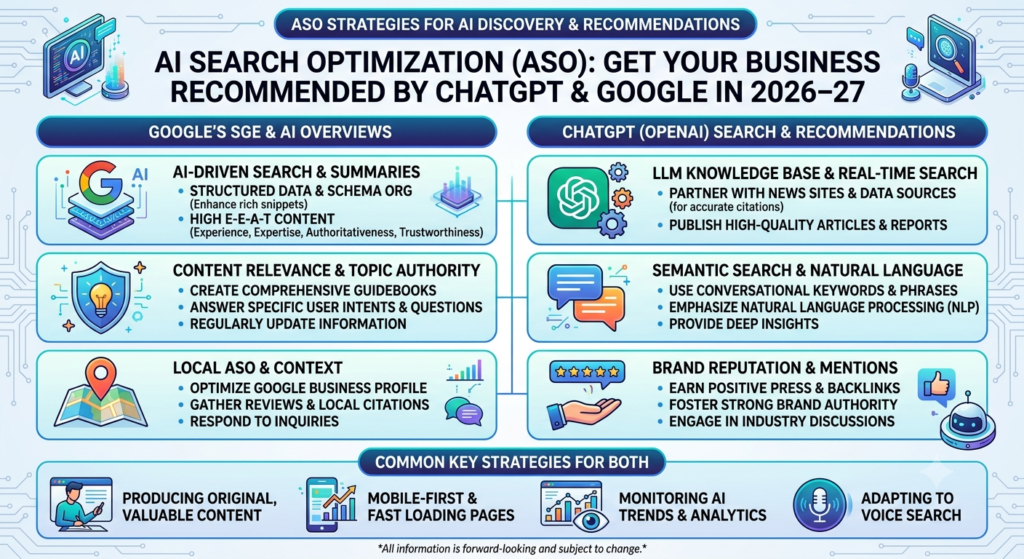
AI search optimization and traditional SEO share many foundational practices, but they differ in how we approach content discovery and user satisfaction.
| Traditional SEO | AI Search Optimization |
|---|---|
| Focuses on organic search visibility and relevant rankings | Focuses on discoverability across AI-assisted search experiences |
| Targets keywords and search intent | Addresses complete questions, conversational queries, and contextual intent |
| Optimizes web pages for search engine understanding | Improves content clarity, structure, and machine readability |
| Encourages relevant organic clicks | Seeks visibility through citations, references, recommendations, and brand mentions where supported |
| Uses backlinks, technical SEO, content quality, and relevance | Builds on these foundations with clear entities, reliable information, and answer-focused content |
These approaches are complementary rather than competing strategies.
We do not need to abandon traditional SEO to optimize for AI search. Instead, we need to strengthen our existing SEO strategy with content that answers questions directly, demonstrates real expertise, and clearly identifies our business, services, and areas of operation.
1. Understand How ChatGPT and Google AI Search Discover Information
To improve our business visibility, we first need to understand the different ways AI-powered search experiences may discover and present information.
ChatGPT and Google do not operate as identical search engines. Their systems may use different combinations of web retrieval, indexed content, knowledge sources, and other information to produce answers.
How ChatGPT Search Can Discover Businesses
ChatGPT can use web search to retrieve relevant information and provide answers with links to sources. When users ask about products, businesses, or services, the information available on websites and other accessible sources may contribute to the response.
We can improve our chances of being discovered by:
- Maintaining an accessible, informative business website.
- Publishing accurate information about our services and expertise.
- Creating useful answers to questions potential customers ask.
- Providing clear business details, including location and contact information.
- Building a consistent and credible online presence.
We should not assume that ChatGPT uses a single fixed ranking formula or that a specific SEO technique guarantees recommendations.
How Google AI Search Can Discover Businesses
Google’s AI-powered search experiences operate within the broader Google Search ecosystem. Relevant, accessible, and useful web content can help Google understand a business and its services.
Our optimization efforts should therefore include conventional SEO foundations, such as crawlability, indexability, helpful content, relevant internal links, and accurate information.
We should also ensure that our website answers specific customer questions in a format that is easy to understand.
The essential principle is to make our business information easy to discover, interpret, and verify.
2. Build a Strong SEO Foundation Before Optimizing for AI
AI search optimization starts with a technically sound website. If important pages cannot be accessed or understood by search engines, our business may miss opportunities to appear in relevant search experiences.
Improve Website Crawling and Indexing
We should ensure that search engines can access our important pages without unnecessary technical barriers.
Our technical SEO checklist should include:
- Creating and submitting an XML sitemap.
- Checking important pages through Google Search Console.
- Avoiding accidental
noindexdirectives on valuable content. - Reviewing robots.txt rules to ensure that essential resources are not unintentionally blocked.
- Fixing broken internal links and unnecessary redirect chains.
- Using canonical tags appropriately.
- Maintaining a logical website structure.
We should also ensure that the website loads reliably on mobile devices and provides a clear user experience.
Use HTTPS and Maintain Website Security
A secure website protects visitors and supports a professional online presence.
We should use HTTPS across all pages, keep the website software updated, and remove unnecessary plugins or scripts that introduce security or performance risks.
For WordPress websites, regular updates, secure authentication, backups, and appropriate access controls are essential operational practices.
Improve Website Speed and Mobile Usability
Many potential customers discover businesses using smartphones. A slow or difficult-to-navigate website can create unnecessary friction. We should optimize image sizes, minimize unnecessary scripts, use appropriate caching, and test important pages on mobile devices.
Our website should make it easy for visitors to understand our services, evaluate our credibility, and contact us.
3. Create AI-Friendly Content That Directly Answers Customer Questions
One of the most practical ways to improve AI search readiness is to publish genuinely useful content that addresses the questions customers ask before making a decision. Instead of producing generic articles around broad keywords, we should focus on the specific information people need.
For example, a website development company could publish content addressing:
- How much does a business website cost in India?
- What features should a small business website include?
- How long does website development take?
- What is the difference between a catalog website and an e-commerce website?
- How can a local business generate leads through its website?
Each article should provide a direct answer before expanding into supporting explanations.
Use the Answer-First Content Structure
A clear structure makes information easier for readers to navigate and understand. We can organize an article using the following format:
- Direct answer: Provide a concise explanation of the main question.
- Detailed explanation: Describe the relevant factors and considerations.
- Practical examples: Show how the information applies to real situations.
- Actionable recommendations: Explain what readers can do next.
- Frequently asked questions: Address closely related concerns.
This approach improves usability and can make important information easier to identify. However, we should not assume that using a particular paragraph length or heading format automatically makes a page eligible for AI recommendations.
Write Naturally for Conversational Search Queries
Customers do not always search using short keyword phrases. They frequently describe their needs in complete sentences.
For example:
- Traditional query: “website designer Guwahati”
- Conversational query: “Who can help us create a professional website for our business in Guwahati?”
Our content should reflect these natural questions without repeating the same phrase unnaturally. We should incorporate relevant terminology, explain unfamiliar concepts, and answer the underlying customer need.
4. Optimize Your Website for Local AI Search and Business Discovery
For businesses serving a particular city or region, local search optimization is an important part of AI search readiness.
A company that provides website development in Guwahati should clearly communicate its location, service area, offerings, and relevant experience.
Maintain Consistent Business Information
We should keep our business name, address, telephone number, website, and other important details consistent wherever they appear.
Relevant platforms may include:
- Our official website.
- Google Business Profile, where eligible.
- Local business directories.
- Industry-specific directories.
- Professional social media profiles.
Inconsistent information can confuse customers and make it more difficult to establish which business details are accurate.
Create Useful Location-Specific Pages
If we serve multiple cities, we can create dedicated location pages that provide meaningful information about each service area. For example, a digital services company may create pages for Guwahati, Shillong, Itanagar, Agartala, and other locations it genuinely serves.
Each page should contain relevant information about the services available in that area, local customer requirements, and practical examples where available. We should avoid publishing dozens of nearly identical city pages simply to target location keywords.
A useful local landing page should help a real customer understand what we offer and how to work with us.
Optimize Google Business Profile
For eligible local businesses, Google Business Profile can help customers discover essential business information through Google Search and Maps. We should maintain accurate operating hours, contact information, service descriptions, and relevant business categories.
We should also encourage genuine customer reviews and respond professionally to customer feedback. We must not fabricate reviews, purchase misleading testimonials, or claim credentials that our business does not possess.
5. Use Structured Data to Help Search Engines Understand Your Business
Structured data is a standardized way of describing information on a web page using a format that search engines can interpret. For suitable pages, we can use Schema.org vocabulary through formats such as JSON-LD.
Depending on the content, relevant schema types may include:
Organizationfor information about an organization.LocalBusinessfor eligible local business details.Servicefor describing a service.Articlefor editorial content.BreadcrumbListfor website navigation.Personfor relevant author information.
For example, a service page may describe the service name, provider, and other details that are genuinely supported by the page. Structured data should accurately reflect visible website content. We should not add invented ratings, false business addresses, unsupported claims, or irrelevant markup.
Structured data helps communicate meaning, but it does not guarantee inclusion in AI-generated answers or enhanced search results.
6. Build Brand Authority Through Credible Online Information
AI search visibility is not only about publishing content on our own website. Customers may encounter information about our business across multiple online sources. We should therefore work toward building a consistent, verifiable reputation.
Publish Original Research and Practical Insights
Original information can make our content more useful than articles that simply repeat common advice.
We can publish:
- Case studies based on actual projects.
- Original surveys and research.
- Before-and-after website improvement examples.
- Detailed service comparisons.
- Industry-specific guides.
- Practical tutorials based on real experience.
For example, a website development agency could explain how it improved a client’s website navigation, mobile usability, or lead-generation process.
Any performance results should be supported by real measurements, with relevant dates and context.
Earn Relevant Backlinks and Brand Mentions
Relevant editorial links and genuine references can help people discover our business and provide useful context about our expertise. We can earn these references through valuable resources, professional partnerships, community participation, and original research.
We should prioritize meaningful relationships over buying large quantities of low-quality backlinks. A brand mention is not automatically an endorsement, and we should not assume that every mention contributes equally to search visibility.
Demonstrate Real Experience and Expertise
Our website should make it clear who is responsible for the content and why readers can trust the information.
We can strengthen credibility by including:
- Accurate author biographies.
- Relevant professional experience.
- Genuine project examples.
- Transparent business information.
- Sources for factual claims.
- Clear explanations of limitations and assumptions.
The objective is to demonstrate real expertise rather than manufacture authority through exaggerated claims.
7. Optimize Service Pages for AI-Powered Business Recommendations
For businesses that sell professional services, well-organized service pages can help customers understand whether a company meets their requirements.
A service page should explain more than the service name.
For example, a website development page should answer the following questions:
- What type of websites do we develop?
- Which businesses can benefit from the service?
- What features and functionality can be included?
- What information is required to begin a project?
- What factors influence project pricing?
- What is the expected development process?
- How can a potential customer request a consultation?
We should clearly distinguish between services we currently provide and services we may offer in the future.
Create Specific Pages for Different Services
Instead of placing every service on one generic page, we can develop dedicated pages for major offerings.
For a digital solutions company, this could include:
- Website Design and Development
- E-commerce Website Development
- Android App Development
- iOS App Development
- Search Engine Optimization
- Local SEO Services
- Social Media Marketing
Each page should have its own purpose, relevant content, and appropriate calls to action. This structure helps customers navigate the website and makes the relationship between the business and its services easier to understand.
8. Use FAQs to Address High-Intent Customer Questions
Frequently asked questions can be valuable when they address genuine concerns that customers have before contacting a business.
For example, a website development company may answer:
How much does website development cost in India?
Website development costs depend on the required features, design complexity, content, integrations, and ongoing maintenance requirements. A basic informational website generally requires a different budget from a complex e-commerce platform or custom web application.
How long does it take to develop a business website?
The timeline depends on the scope of work, content availability, design approvals, functionality, and testing requirements. We should provide a realistic project estimate after understanding the customer’s requirements.
Does a small business need SEO?
SEO can help a business improve its visibility for relevant searches. Its usefulness depends on customer demand, competition, business objectives, website quality, and the resources available for ongoing optimization.
Can AI tools guarantee that a business will be recommended by ChatGPT?
No. There is no reliable method that guarantees a business will be recommended in every relevant ChatGPT response. AI-generated answers can vary according to the question, available sources, and retrieval processes.
We should write FAQs for customers rather than treating them as a way to manipulate search systems.
9. Optimize Content for Different Types of AI Search Intent
AI search users may be looking for explanations, comparisons, recommendations, or specific services.
Our content strategy should address these different needs.
| Search intent | Example content |
|---|---|
| Informational | What is local SEO and how does it work? |
| Comparative | Website vs. mobile app: which should a business consider? |
| Commercial | Website development services for small businesses |
| Transactional | Request a website development quotation |
| Local | Website designers serving businesses in Guwahati |
We should connect related pages through useful internal links.
For example, an article explaining local SEO can link to our Local SEO service page. A guide about e-commerce development can link to our e-commerce quotation or consultation page.
This creates a more useful experience and helps visitors move from learning about a subject to exploring relevant services.
10. Measure AI Search Visibility and Business Results
AI search optimization requires measurement, but we should distinguish between what we can directly observe and what we can only estimate.
We can use Google Search Console to monitor organic search performance, including impressions, clicks, click-through rates, and average positions for eligible search results.
Google Analytics or another analytics platform can help us understand website engagement and conversions.
For AI search visibility, we can also conduct structured manual checks.
Create a Repeatable AI Search Testing Process
We can develop a list of relevant customer questions and test them periodically across supported AI search experiences.
For example:
- Which companies provide website development in Guwahati?
- What should a small business consider before hiring an SEO agency?
- What features should a business website include?
- Which factors affect the cost of developing a mobile application?
We should record the date, exact query, platform, whether our business appeared, and any cited sources.
These checks are observations, not definitive measurements of total AI visibility. Responses can change, and manually testing a small number of prompts cannot establish how frequently a business appears across all users.
Track Business Outcomes
Ultimately, our goal should be to understand whether our digital presence helps customers discover and engage with our services.
Useful metrics include:
- Qualified website enquiries.
- Consultation requests.
- Relevant organic search traffic.
- Conversion rates on service pages.
- Leads from local search.
- Referral traffic from identifiable sources.
- Customer acquisition costs.
We should use these measurements to improve our content and website experience rather than relying solely on whether our brand appears in a particular AI response.
11. Common AI Search Optimization Mistakes to Avoid
Businesses can waste time and resources by following unverified tactics or focusing on superficial changes.
We should avoid the following mistakes.
Keyword Stuffing and Repetitive Content
Repeating “best website development company” dozens of times does not make a page more helpful. We should use natural language and focus on answering the customer’s actual question.
Publishing Large Volumes of Low-Value AI Content
AI tools can support research, outlining, editing, and content development. However, publishing large quantities of generic, unverified material can reduce content quality.
We should review facts, add relevant expertise, verify examples, and ensure that each page serves a genuine purpose.
Using Fake Reviews or Unsupported Claims
False testimonials, fabricated case studies, and exaggerated credentials can damage customer trust.
We should publish only authentic, supportable information about our business.
Assuming Special AI Metadata Guarantees Recommendations
There is no universal metadata tag or secret prompt that guarantees a business will be recommended by ChatGPT or Google AI search.
We should focus on accessible content, reliable information, relevant expertise, and a strong user experience.
Ignoring Traditional SEO
AI search optimization does not eliminate the importance of technical SEO, useful content, or relevant links.
These foundations remain central to maintaining a discoverable and informative website.
12. A Practical 90-Day AI Search Optimization Plan for Businesses
We can organize our optimization work into three stages.
01
Days 1–30: Build the Foundation
Technical SEO, business accuracy, and content planning
- Audit website indexing, mobile usability, and page speed.
- Update business information across relevant platforms.
- Improve the homepage and main service pages.
- Identify important customer questions.
- Set up appropriate analytics and search performance tracking.
02
Days 31–60: Develop Helpful Content
Answer-focused articles and service-specific resources
- Publish detailed guides addressing high-intent questions.
- Create or improve relevant service pages.
- Add genuine case studies and professional information.
- Implement appropriate structured data.
- Improve internal links between related articles and services.
03
Days 61–90: Measure and Improve
Search visibility, content refinement, and lead generation
- Review search impressions, clicks, and relevant conversions.
- Test representative customer questions across AI search platforms.
- Identify content gaps and improve underperforming pages.
- Strengthen relevant local and industry references.
- Refine calls to action and enquiry forms.
This 90-day plan provides a practical starting framework. The time required for measurable results will vary depending on the website’s current condition, competition, publishing capacity, and other circumstances.
Conclusion:
AI-powered search is creating new ways for people to discover businesses, learn about services, and evaluate potential providers. To prepare for these changes in 2026–27, we should develop a digital presence that communicates our business identity, services, expertise, and customer value clearly.
Our strategy should combine strong technical SEO, helpful content, accurate business information, credible references, structured data, and a user-friendly website.
We should also avoid relying on unsupported promises about guaranteed AI recommendations or secret optimization techniques.
For businesses such as website development companies, digital marketing agencies, consultants, and local service providers, the practical opportunity is to create useful resources that answer customer questions and connect those answers to relevant services.
By consistently improving our website, publishing trustworthy information, and measuring meaningful business outcomes, we can build a stronger foundation for discovery across traditional search engines and evolving AI-powered search experiences.
The goal is not simply to appear in an AI-generated answer. It is to become a business whose information is useful, accurate, relevant, and worthy of customer trust.