The hospitality industry is rapidly embracing digital technology to improve guest experiences, simplify reservations, and increase revenue. Hotel booking app development has become an important investment for hotels, resorts, boutique properties, travel companies, and hospitality startups looking to reach more customers and streamline their operations. A well-designed hotel booking application allows travellers to discover accommodation, compare room prices, check availability, make secure reservations, and manage their bookings directly from their smartphones.
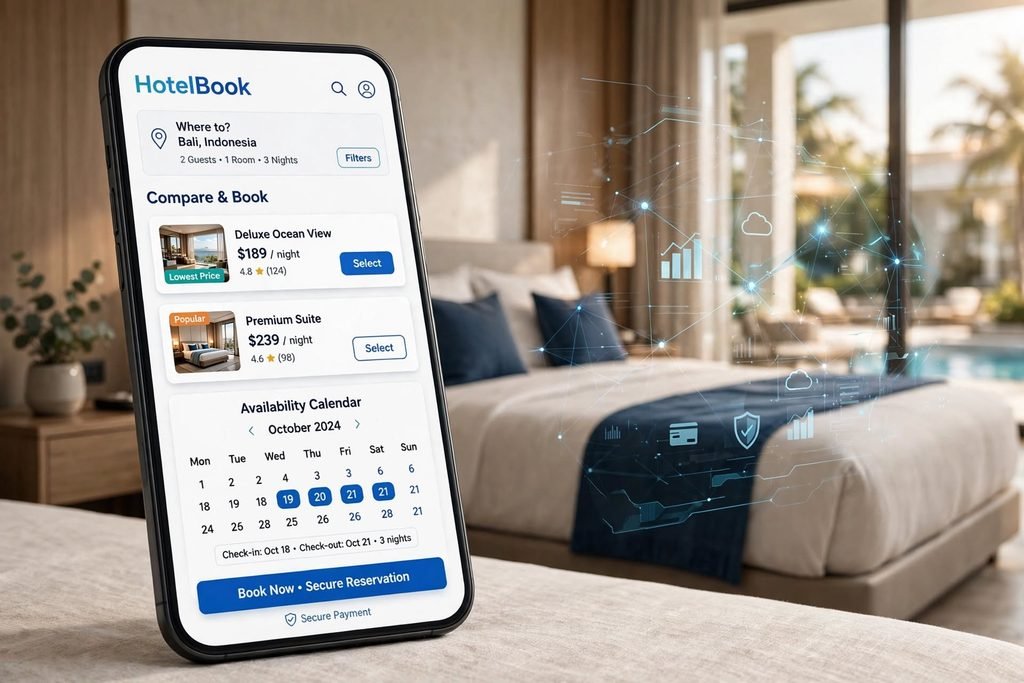
For hotel businesses, a dedicated mobile application offers more than a convenient booking channel. It creates a direct connection with customers, reduces dependence on third-party booking platforms, supports personalised marketing, and provides valuable insights into guest preferences. With the right features and technology, we can develop a hotel booking app that improves operational efficiency while delivering a seamless experience from the first search to checkout.
In this comprehensive guide, we explore the essential features, development process, technology options, cost factors, and business advantages of building a hotel booking application.
What Is Hotel Booking App Development?
Hotel booking app development is the process of designing, building, testing, and maintaining a mobile application that enables users to search for hotels and reserve accommodation online.
These applications connect travellers with hotels through a digital platform that displays room availability, pricing, property information, photographs, amenities, customer reviews, and booking policies. Depending on the business model, an application may serve a single hotel, a hotel chain, a travel agency, or a marketplace featuring multiple accommodation providers.
We generally divide hotel booking applications into three categories:
1. Hotel Booking Apps for Individual Properties
A hotel-specific booking application allows a hotel or resort to manage its own digital reservations. Customers can explore available rooms, review amenities, select dates, make payments, and receive booking confirmations.
This model is suitable for independent hotels, luxury resorts, boutique properties, and hospitality businesses that want to strengthen their brand identity and encourage direct reservations.
2. Multi-Hotel Booking Platforms
A multi-hotel booking application brings accommodation providers together on a single platform. Users can compare properties, filter results by price or location, read reviews, and reserve rooms according to their preferences.
This model is suitable for entrepreneurs building accommodation marketplaces, regional hotel directories, travel startups, and businesses targeting domestic or international travellers.
3. Hotel Management and Reservation Apps
Hotel management applications focus on internal operations, including reservation management, room allocation, housekeeping coordination, guest communication, and payment tracking.
Some platforms combine these operational tools with customer-facing booking features, creating an integrated digital solution for the hospitality business.
Why Should Businesses Invest in Hotel Booking App Development?
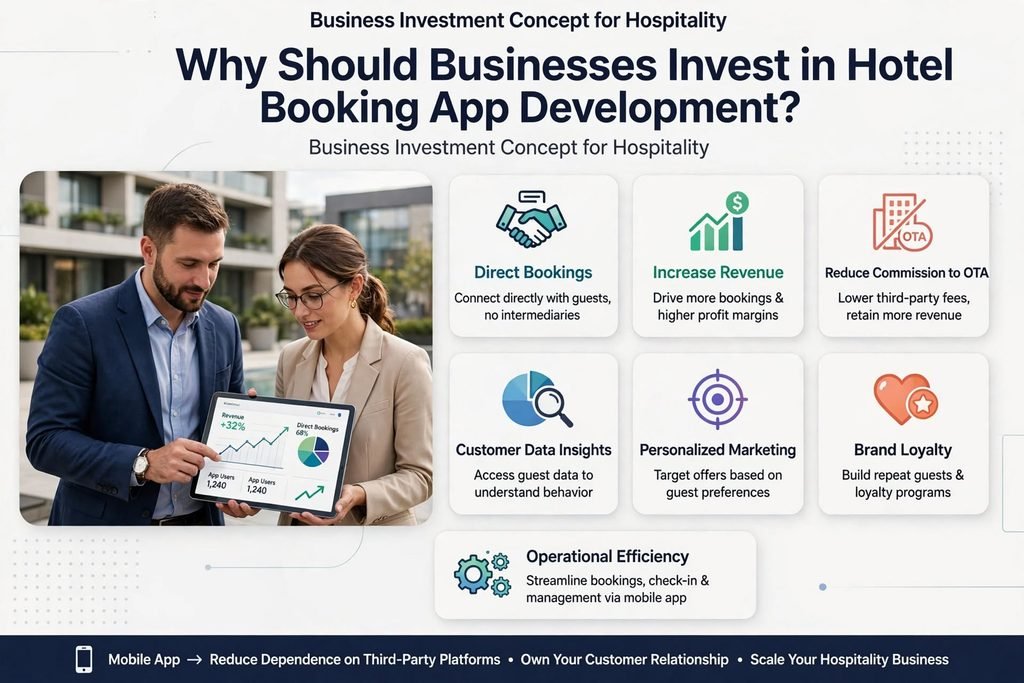
The way travellers research and book accommodation has changed considerably. Customers increasingly expect real-time availability, transparent pricing, secure payments, and convenient access to booking information.
A dedicated hotel booking app helps hospitality businesses meet these expectations while building stronger relationships with their customers.
Increase Direct Hotel Bookings
Hotels often rely on online travel agencies and third-party reservation platforms to reach potential guests. Although these channels can generate bookings, commissions and platform dependency can affect profitability.
With a branded hotel booking application, we can provide customers with a direct reservation channel. Hotels can promote exclusive offers, loyalty benefits, seasonal discounts, and special packages to encourage repeat bookings.
Improve Customer Experience
A well-designed application simplifies the entire reservation journey. Travellers can search for accommodation, compare room categories, view photographs, select check-in and check-out dates, and complete bookings without navigating complicated processes.
Features such as saved preferences, instant booking confirmations, digital receipts, and booking reminders further improve convenience.
Strengthen Brand Recognition
A dedicated mobile application keeps a hotel’s brand accessible on customers’ devices. Branded notifications, personalised offers, loyalty rewards, and consistent visual design help businesses remain connected with guests before, during, and after their stay.
Automate Reservation Management
A hotel booking platform can automate several repetitive activities, including reservation confirmations, payment notifications, cancellation updates, and customer communication.
When integrated with hotel management software, the application can also synchronise room availability and reservation records, reducing manual work and the risk of booking errors.
Access Valuable Business Insights
Booking applications generate useful information about customer behaviour, popular room categories, booking periods, cancellation patterns, and promotional performance.
We can use these insights to help hotel businesses improve pricing strategies, refine marketing campaigns, and make better operational decisions.
Essential Features of a Hotel Booking App
The success of a hotel booking application depends on how effectively its features address customer expectations and business requirements. We recommend prioritising the following functionalities during development.
1. User Registration and Login
The registration system should allow customers to create accounts quickly and securely. Depending on the target audience, we can support email registration, mobile number verification, and compatible social sign-in options.
Users should be able to manage their profiles, update contact information, save preferences, and access previous reservations.
2. Hotel Search and Advanced Filters
A powerful search function helps users find suitable accommodation without unnecessary effort.
Essential search and filtering options include:
- Destination, city, or neighbourhood.
- Check-in and check-out dates.
- Number of guests and rooms.
- Minimum and maximum room prices.
- Hotel category and star rating.
- Available amenities such as Wi-Fi, parking, swimming pools, and breakfast.
- Guest ratings and review scores.
- Property types, including hotels, resorts, and boutique accommodation.
Accurate search results and responsive filtering improve usability and help customers make informed booking decisions.
3. Real-Time Room Availability
Real-time availability is one of the most important features of a hotel reservation application. Customers should see whether a room is available for their selected dates before proceeding to checkout.
For larger operations, we can integrate the application with a Property Management System (PMS) or channel manager. These integrations help synchronise room inventory, reservations, and pricing across supported sales channels.
4. Detailed Hotel and Room Listings
Each hotel listing should provide comprehensive information to support booking decisions.
We typically include:
- Hotel name, location, and contact details.
- High-quality photographs and room galleries.
- Room types, occupancy limits, and bed configurations.
- Amenities and available services.
- Check-in and check-out policies.
- Cancellation and refund conditions.
- Taxes, additional charges, and total booking prices.
- Guest reviews and ratings.
- Maps and directions.
Transparent information helps customers understand what they are purchasing and reduces confusion during the reservation process.
5. Secure Online Payment Gateway
A secure payment system allows customers to pay for reservations conveniently. Depending on the target market and payment provider, the application may support credit cards, debit cards, UPI, digital wallets, and other locally available payment methods.
For Indian customers, suitable payment gateway integrations can simplify payments through supported UPI applications and cards.
We also recommend implementing transaction status verification, payment failure handling, refund workflows, and appropriate safeguards for sensitive payment information.
6. Booking Confirmation and Notifications
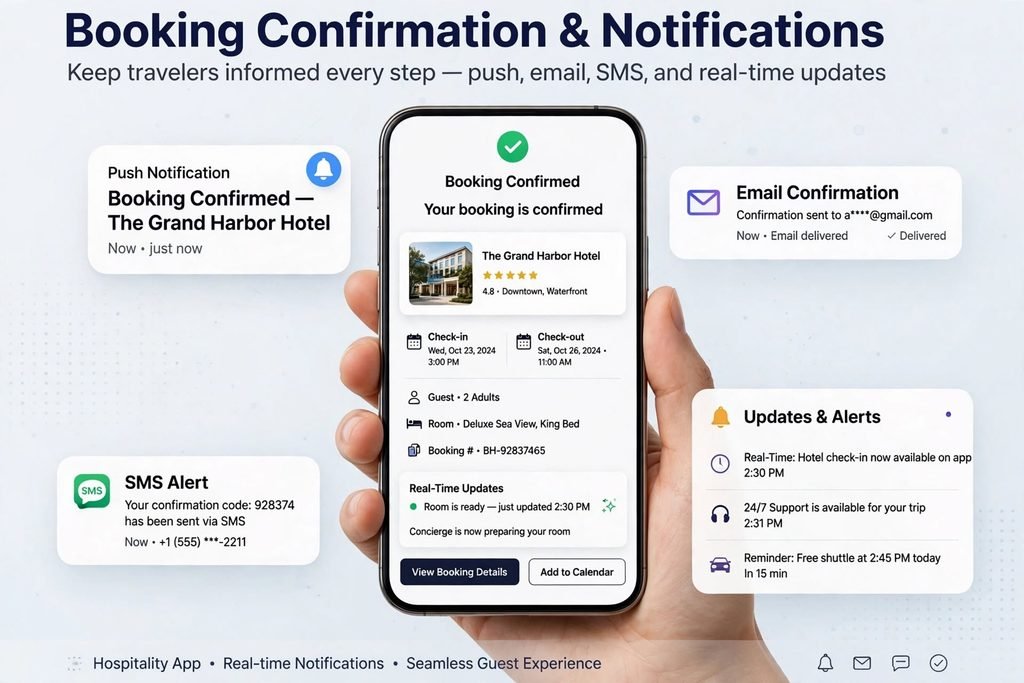
Customers should receive clear confirmation after completing a reservation.
Notifications can provide information about:
- Successful bookings.
- Payment status.
- Reservation cancellations.
- Refund updates.
- Upcoming check-in dates.
- Special offers and loyalty rewards.
Push notifications, email, and SMS can be used according to customer preferences, platform capabilities, and applicable consent requirements.
7. Booking History and Cancellation Management
A customer dashboard should display upcoming stays, completed bookings, and cancelled reservations.
Users should be able to review reservation details, download receipts, request changes, and cancel eligible bookings according to the property’s policies.
Automated workflows can calculate applicable cancellation charges and initiate refund processes through the relevant payment provider.
8. Customer Reviews and Ratings
Reviews help travellers evaluate accommodation based on previous guests’ experiences.
We can implement verified-stay reviews, rating categories, written feedback, and property responses. Moderation tools should help administrators manage abusive content and fraudulent reviews.
9. Maps and Location-Based Search
Location-based discovery helps users find hotels near airports, railway stations, tourist attractions, business districts, hospitals, and other important destinations.
Map integration can display property locations, nearby attractions, and directions. Search results can also be organised by distance, making the application more useful for travellers who prioritise location.
10. Loyalty Programmes and Promotional Offers
Loyalty programmes encourage repeat bookings by rewarding customers for their continued engagement.
Possible features include membership levels, discount coupons, referral rewards, promotional codes, and points-based benefits. We can configure eligibility rules and redemption conditions according to the hotel’s commercial strategy.
Advanced Features for a Competitive Hotel Booking Application
Once the core booking experience is reliable, businesses can introduce advanced features to differentiate their applications.
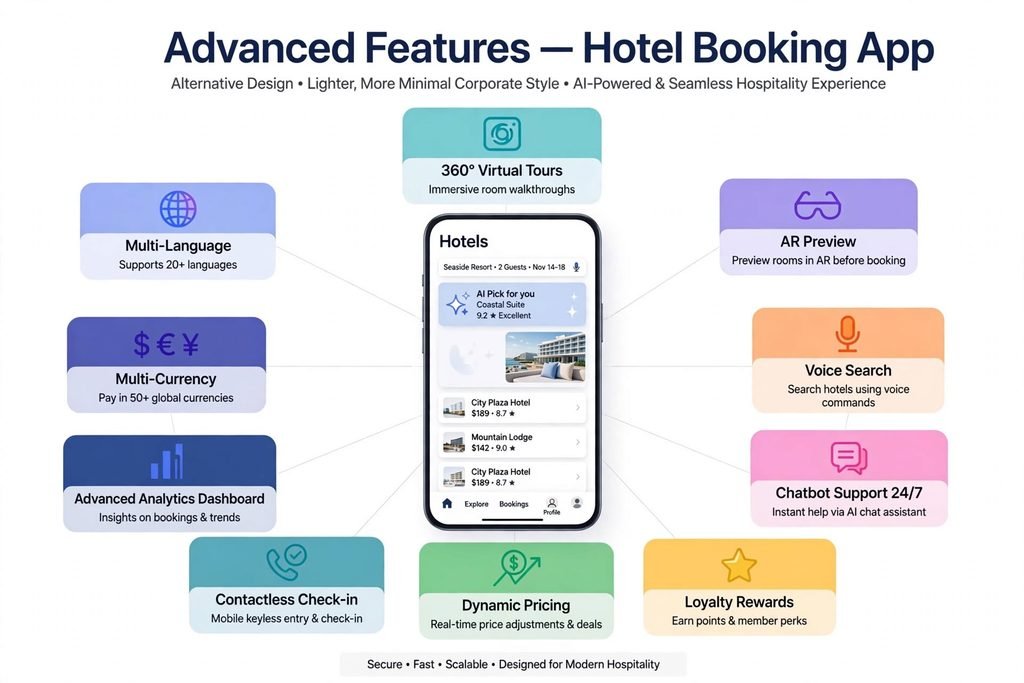
AI-Powered Hotel Recommendations
Artificial intelligence can analyse permitted user preferences, previous searches, and booking patterns to recommend relevant accommodation.
For example, a family searching for a holiday destination may receive suggestions for properties with family rooms, breakfast, swimming pools, and convenient access to attractions.
Recommendations should remain transparent and allow users to refine or change their preferences.
AI Chatbots for Customer Support
An integrated chatbot can answer common questions about room availability, hotel facilities, check-in policies, reservation status, and cancellation rules.
For more complex issues, the chatbot should transfer the conversation to a human support representative.
Multilingual Support
Multilingual interfaces can help businesses reach customers who prefer different languages. This feature can be especially useful for regional hotel brands serving domestic tourists and international visitors.
The application should provide consistent translations for booking policies, payment instructions, room descriptions, and customer support.
Dynamic Pricing Integration
Dynamic pricing tools can help hotels adjust room rates based on demand, seasonal patterns, local events, and occupancy levels.
These systems require appropriate business rules and reliable inventory data. Prices should be displayed clearly, with applicable taxes and fees disclosed before payment.
Contactless Check-In and Digital Services
Depending on the hotel’s operational setup, an application can support digital check-in forms, arrival instructions, requests for additional services, and digital invoices.
More advanced implementations may integrate with compatible access-control systems, although identity verification and security requirements must be considered carefully.
Hotel Booking App Development Process
Developing a reliable booking application requires structured planning, thoughtful design, and thorough testing. We follow a phased approach to ensure that the solution meets business objectives and provides a consistent customer experience.
Step 1: Business Analysis and Market Research
We begin by identifying the target audience, business model, competitive environment, and commercial objectives.
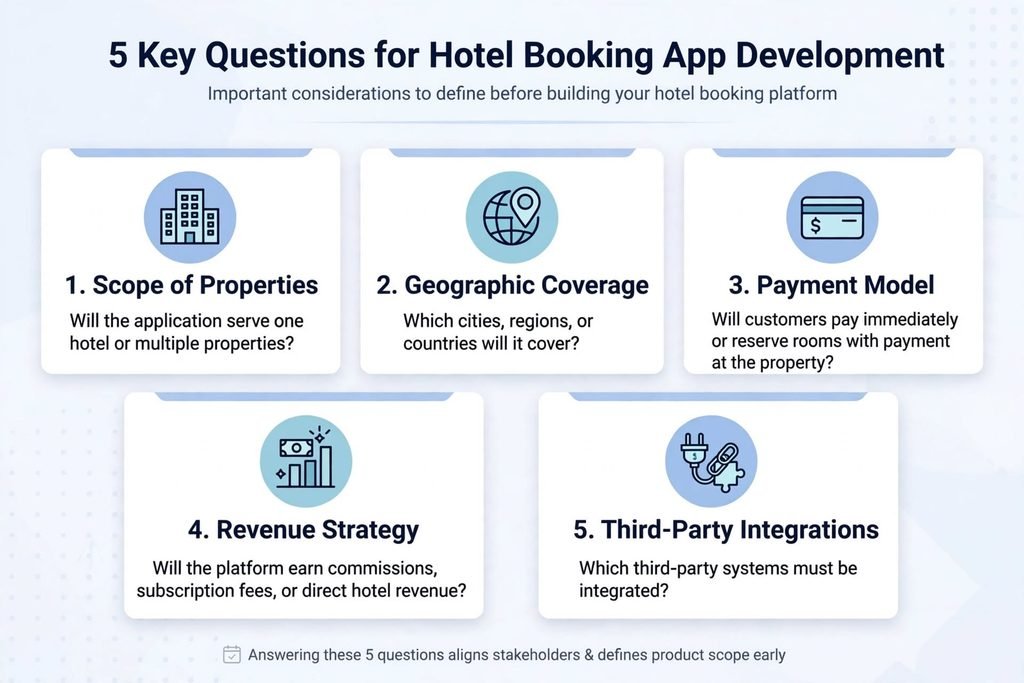
Important questions include:
- Will the application serve one hotel or multiple properties?
- Which cities, regions, or countries will it cover?
- Will customers pay immediately or reserve rooms with payment at the property?
- Will the platform earn commissions, subscription fees, or direct hotel revenue?
- Which third-party systems must be integrated?
The answers help determine the application’s scope, required features, and initial development budget.
Step 2: Feature Planning and Technical Architecture
We prepare a detailed feature list and prioritise functionality for the initial release.
For many businesses, a Minimum Viable Product (MVP) is a practical starting point. An MVP may include hotel listings, search filters, room availability, booking management, payments, notifications, and an administrative dashboard.
Advanced capabilities can be introduced after the core reservation system has been tested with real customers.
Step 3: UI/UX Design
The design process focuses on making hotel discovery and reservations simple.
We create wireframes, user journeys, and interactive prototypes before implementing the final interface. The design should work across different screen sizes and make room details, prices, cancellation rules, and booking actions easy to understand.
A well-designed booking flow reduces unnecessary steps and helps customers complete reservations with confidence.
Step 4: Frontend and Backend Development
Frontend development covers the screens and interactions customers use. Backend development handles business logic, databases, authentication, reservation processing, payment verification, and administrative functions.
The architecture should account for concurrent bookings, inventory updates, data security, and the possibility of increased traffic during holidays or promotional campaigns.
Step 5: Third-Party Integrations
Depending on the project, we may integrate:
- Payment gateways.
- Maps and geolocation services.
- Hotel property management systems.
- Channel managers and booking inventory providers.
- Email and SMS services.
- Push notification platforms.
- Analytics and customer relationship management tools.
Integration requirements can substantially influence both development time and total project cost.
Step 6: Testing and Quality Assurance
Before launch, we test the application across supported devices and operating systems.
Testing should cover account registration, hotel search, room availability, booking confirmation, payment success and failure, cancellations, refunds, and notification delivery.
We also assess performance, accessibility, security, and usability. Particular attention should be paid to preventing duplicate reservations and handling simultaneous booking requests correctly.
Step 7: Deployment and Launch
After successful testing, we prepare the production environment and publish the application through the relevant distribution channels.
For native mobile applications, this may involve submission to the Apple App Store and Google Play Store, subject to their review requirements and policies.
We also configure monitoring, backups, error reporting, analytics, and administrative access.
Step 8: Maintenance and Continuous Improvement
Hotel booking applications require ongoing maintenance to remain secure, reliable, and compatible with evolving mobile platforms.
Post-launch work may include bug fixes, performance improvements, operating system compatibility updates, new features, integration changes, and customer feedback analysis.
Regular maintenance helps protect the application’s long-term value.
Technology Stack for Hotel Booking App Development
The appropriate technology stack depends on the project’s complexity, target audience, integration requirements, and expected traffic.
| Technology layer | Possible technologies |
|---|---|
| Android development | Kotlin |
| iOS development | Swift |
| Cross-platform mobile apps | Flutter, React Native |
| Web frontend | React, Next.js |
| Backend development | Node.js, Python, Java, or PHP |
| Database | PostgreSQL, MySQL, or MongoDB |
| Cloud infrastructure | AWS, Microsoft Azure, or Google Cloud |
| Maps and navigation | Google Maps Platform or compatible providers |
| Payment processing | Supported payment gateway APIs |
| Analytics | Firebase Analytics or comparable platforms |
For businesses targeting both Android and iOS users, cross-platform development can reduce duplicated development effort when the application’s requirements are compatible with a shared codebase.
Native development may be preferable when a project requires platform-specific capabilities, highly specialised interactions, or deeper operating system integration.
We select the technology stack according to practical project requirements rather than choosing technologies solely because they are popular.
How Much Does Hotel Booking App Development Cost?
The cost of hotel booking app development depends on the number of features, supported platforms, design complexity, backend architecture, external integrations, and development team’s location and experience.
The following figures are illustrative planning estimates in Indian rupees, not verified market quotations.
| Development level | Estimated cost |
|---|---|
| Basic hotel booking MVP | ₹3 lakh–₹7 lakh |
| Mid-level booking application | ₹7 lakh–₹18 lakh |
| Advanced multi-hotel platform | ₹18 lakh–₹40 lakh or more |
| Enterprise-grade booking ecosystem | ₹40 lakh–₹1 crore or more |
These estimates may exclude GST, third-party service charges, payment gateway fees, licensing, extensive hotel inventory integrations, and ongoing maintenance. Actual quotations can vary considerably.
Factors That Influence Development Cost
Number of platforms: Building Android, iOS, and web applications may require more resources than launching on a single platform.
Feature complexity: AI recommendations, loyalty systems, advanced analytics, multilingual support, and dynamic pricing increase implementation requirements.
Backend infrastructure: A multi-hotel marketplace with complex inventory management requires more sophisticated architecture than a simple application for one property.
Third-party integrations: PMS, channel manager, payment gateway, and external inventory integrations may involve additional development work and recurring fees.
UI/UX design: Custom branding, advanced interactions, accessibility requirements, and extensive usability testing affect design costs.
Security and compliance: Authentication, secure data handling, payment workflows, monitoring, and privacy controls must be included in the project plan.
Maintenance: Server hosting, support, bug fixes, upgrades, and third-party subscriptions should be budgeted separately from initial development.
How Can We Reduce Hotel Booking App Development Costs?
We can manage the initial investment by starting with a focused MVP, selecting a technology stack that matches the requirements, and avoiding unnecessary customisation.
Businesses should also validate their booking workflow before investing in advanced features. For example, a regional hotel startup may initially need property listings, room availability, reservations, payments, and an admin dashboard rather than a sophisticated AI recommendation engine.
A phased development strategy allows the business to evaluate customer demand before expanding the product.
Revenue Models for Hotel Booking Applications
A sustainable revenue model should align with the target market and the value delivered to participating businesses.
1. Commission-Based Model
A booking marketplace earns a commission on qualifying reservations made through the platform. Commission rates and payment arrangements depend on contracts with accommodation providers.
2. Subscription-Based Model
Hotels pay a recurring fee to use the platform or its management tools. Different subscription tiers can provide different limits, integrations, reporting features, and support levels.
3. Featured Listings and Sponsored Placement
Hotels can pay for clearly labelled promotional placements, subject to platform policies and applicable advertising requirements.
4. Direct Booking Revenue
An individual hotel uses its application to generate direct room reservations. Revenue comes from accommodation sales and any additional services offered to guests.
5. Additional Hospitality Services
Subject to the business model, the application may also facilitate airport transfers, tours, restaurant reservations, or other travel-related services.
The best model depends on the customer acquisition strategy, operational costs, market positioning, and agreements with accommodation providers.
Hotel Booking App Security and Data Protection
Security is essential because hotel booking applications handle personal information, reservation details, and potentially sensitive payment-related data.
We recommend implementing the following safeguards:
- Encrypted communication using HTTPS and current TLS configurations.
- Secure authentication and appropriate account recovery procedures.
- Role-based access controls for administrators and hotel staff.
- Server-side validation of prices, availability, and booking requests.
- Payment gateway integrations that minimise direct handling of card data.
- Protection against common application vulnerabilities.
- Secure database configuration, backups, and access logging.
- Rate limiting and monitoring for suspicious activity.
- Clear privacy notices and appropriate data retention policies.
- Regular security testing and dependency updates.
The platform should also comply with applicable privacy and consumer-protection requirements in its operating markets. Where relevant, payment processing should be designed around the applicable PCI DSS requirements and the payment provider’s security guidance.
Security should be incorporated from the architecture and design stages instead of being treated as a final pre-launch task.
Common Challenges in Hotel Booking App Development
Developing a hotel booking application involves several challenges that must be addressed during planning and implementation.
Managing Accurate Room Inventory
Availability must remain consistent across the hotel’s website, application, reception system, and connected booking channels.
We address this through reliable inventory synchronisation, appropriate locking or reservation-hold mechanisms, and transaction-safe booking workflows.
Preventing Booking Failures
Payment interruptions, slow networks, and duplicate requests can create uncertainty for customers.
Clear transaction states, idempotent booking operations, payment reconciliation, and automated notifications help prevent duplicate bookings and improve recovery from failed transactions.
Building Customer Trust
Customers need accurate room descriptions, transparent pricing, clear cancellation policies, and dependable support.
We can strengthen trust by displaying complete booking details before payment, issuing confirmation promptly, and providing accessible customer service.
Competing With Established Booking Platforms
New applications must offer a compelling reason for customers to choose them.
A regional platform might focus on verified local properties, specialised accommodation categories, regional language support, personalised assistance, or a superior direct-booking experience.
Maintaining Performance During Peak Demand
Holiday periods, local events, and promotional campaigns may generate sudden traffic increases.
Scalable infrastructure, caching where appropriate, database optimisation, monitoring, and load testing help the application remain responsive during busy periods.
How to Choose the Right Hotel Booking App Development Company
Selecting an experienced development partner can make a significant difference to the project’s quality and long-term maintainability.
Before finalising a development company, we recommend evaluating the following factors.
Relevant portfolio: Review previous mobile applications, reservation systems, marketplaces, and hospitality projects. Ask for demonstrations where possible.
Technical capabilities: Confirm that the team understands mobile development, backend architecture, database design, API integrations, security, and deployment.
Transparent pricing: Request a written proposal covering deliverables, exclusions, milestones, payment terms, and ongoing costs.
Communication and project management: Establish how requirements, progress updates, testing feedback, and change requests will be handled.
Ownership and documentation: Clarify ownership of source code, design files, cloud accounts, app store accounts, and project documentation.
Maintenance and support: Understand what happens after launch, including bug fixes, security updates, service-level expectations, and additional feature development.
A reliable development partner should explain technical trade-offs clearly and provide a realistic roadmap based on the business’s requirements.
Future Trends in Hotel Booking App Development
Hotel booking applications continue to evolve as travellers expect more personalised, flexible, and convenient digital services.
Artificial Intelligence and Personalisation
AI-assisted discovery can help travellers find accommodation that matches their preferences. Automated support and intelligent search can also simplify the reservation process.
Voice-Assisted Search
Voice interfaces may allow users to search for hotels by destination, budget, dates, and preferred amenities, depending on device capabilities and application design.
Augmented Reality and Virtual Tours
Interactive property previews and virtual tours can help customers understand room layouts, facilities, and the overall accommodation experience before making a reservation.
Sustainable Travel Filters
Travellers may increasingly look for properties with relevant sustainability certifications, energy-efficient facilities, or recognised environmental initiatives. Applications can support these preferences when reliable data is available.
Contactless Hospitality
Digital check-in, mobile service requests, online invoices, and compatible smart-room integrations can reduce friction during a guest’s stay.
Personalised Guest Engagement
With appropriate consent and privacy safeguards, hotels can use customer preferences to provide relevant recommendations, arrival information, and loyalty benefits.
Businesses should prioritise trends that solve genuine customer problems rather than adopting new technology without a clear commercial purpose.
Frequently Asked Questions About Hotel Booking App Development
1. How long does it take to develop a hotel booking app?
A basic MVP may take approximately 8–16 weeks, while a more complex multi-hotel platform may require several months or longer. The timeline depends on feature scope, design, integrations, testing, and approval requirements.
2. Can we develop an app for both Android and iOS?
Yes. We can develop separate native applications or use a cross-platform framework such as Flutter or React Native. The appropriate approach depends on the required features, performance expectations, and budget.
3. Is it possible to build a hotel booking app for a single hotel?
Yes. A single-property application can include room listings, availability checks, direct reservations, online payments, customer notifications, and an administrative dashboard. It generally requires less complex inventory management than a multi-hotel marketplace.
4. Do we need a website along with a hotel booking app?
A responsive website is highly useful because customers can discover the business through search engines and access booking services without installing an application. A website and mobile app can share backend services and reservation data when designed appropriately.
5. Can we integrate online payments into a hotel booking app?
Yes. Suitable payment gateway APIs can support available payment methods, transaction verification, refunds, and payment status updates. The supported methods depend on the selected provider, business eligibility, and operating market.
6. Can a hotel booking app connect with existing hotel management software?
Yes, where the relevant software provides a suitable API or supported integration. The scope depends on inventory synchronisation, reservation updates, room pricing, and the capabilities of the existing system.
7. What is the best technology for hotel booking app development?
There is no single best technology for every project. Flutter and React Native can support cross-platform applications, while Kotlin and Swift are options for native Android and iOS development. Backend and database choices should reflect the application’s complexity and integration requirements.
8. How can a hotel booking app generate revenue?
Revenue can come from direct room bookings, commissions, subscriptions, clearly labelled sponsored listings, or additional hospitality services. Individual hotels and multi-property marketplaces typically use different revenue models.
9. Does a hotel booking app require regular maintenance?
Yes. Regular maintenance helps address software bugs, security vulnerabilities, operating system changes, API updates, performance issues, and evolving customer requirements.
10. Can a small hotel business afford a booking application?
Yes. A small business can begin with a focused solution or a mobile-friendly booking website and expand its capabilities as demand grows. The initial budget should prioritise dependable reservations, accurate availability, secure payments, and a manageable operating model.
Conclusion: Build a Scalable Hotel Booking App for Long-Term Growth
Hotel booking app development provides hotels, resorts, travel entrepreneurs, and hospitality startups with an opportunity to improve reservation management, strengthen customer relationships, and create new digital revenue channels.
The most effective approach begins with a clear business model, a straightforward booking experience, accurate room availability, secure payment processing, and reliable administrative tools. Advanced capabilities such as AI-powered recommendations, loyalty programmes, multilingual interfaces, and hotel management integrations can be introduced as the business expands.
We recommend starting with a carefully scoped product that addresses the most important customer and operational needs. With suitable technology, thoughtful design, robust security, and continuous improvement, a hotel booking application can become a valuable long-term asset for a growing hospitality business.
Whether the objective is to digitise a single hotel or launch a multi-property reservation marketplace, the right development strategy can help transform a business idea into a practical, scalable digital solution.