In today’s digital-first marketplace, businesses need a strong online presence to attract customers, build credibility, generate leads, and increase sales. Two of the most common ways to establish that presence are creating a business website and maintaining a Facebook Page.
At first glance, a Facebook Page may appear to be enough. It is quick to create, easy to update, and provides access to a massive social media audience. However, a professional website and a Facebook Page serve very different purposes. While Facebook is an excellent platform for communication, engagement, and promotion, a website provides a business with greater control, credibility, search visibility, and long-term digital ownership.
For businesses that want sustainable growth, the question should not necessarily be “Website or Facebook Page?” Instead, we should consider how both platforms can work together.
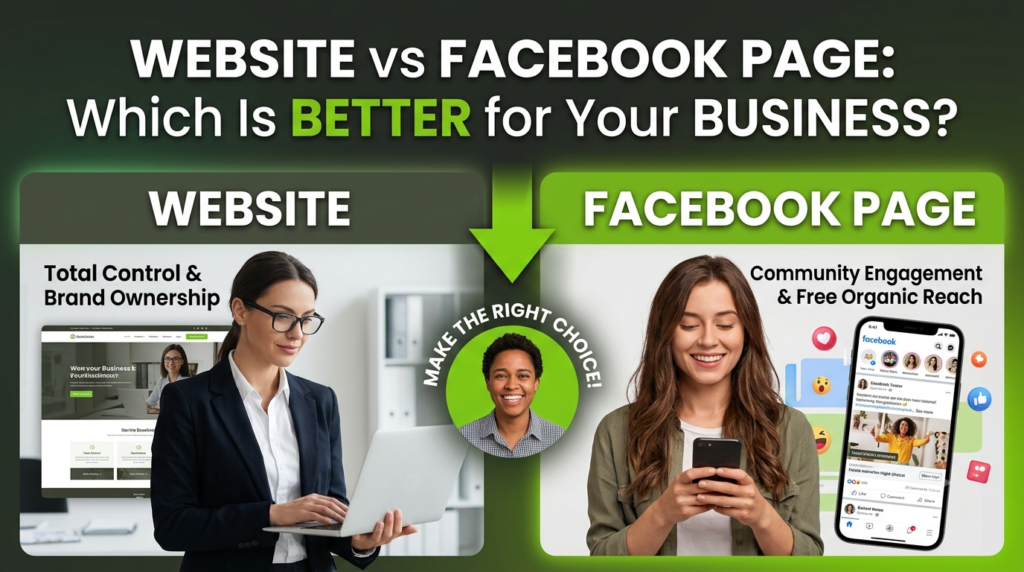
Website vs Facebook Page: The Key Difference
The fundamental difference is ownership and control. A business website is a digital property that we control. We choose the domain name, hosting provider, design, content, functionality, branding, customer journey, and integrations.
A Facebook Page exists within Meta’s social media ecosystem. We can customize many aspects of the Page, but the platform itself, its policies, algorithms, features, and distribution mechanisms remain outside our direct control.
| Feature | Business Website | Facebook Page |
|---|---|---|
| Ownership | Business-controlled | Platform-controlled |
| Custom domain | Yes | No |
| Google search visibility | Strong potential | Limited and dependent on platform |
| Branding control | Very high | Limited |
| Design flexibility | Extensive | Limited |
| Lead generation | Highly customizable | Available |
| Online payments | Yes | Limited/integration dependent |
| SEO | Full SEO capabilities | Limited |
| Content control | High | Subject to platform policies |
| Customer data | Can be integrated and managed | Platform-dependent |
| E-commerce | Highly customizable | Available through platform features/integrations |
| Professional credibility | High | Moderate to high |
| Long-term digital asset | Yes | No |
| Social engagement | Moderate | Excellent |
This comparison shows why a website and Facebook Page should not be viewed as identical digital assets.
Why Every Business Needs a Website
A website acts as the central digital hub of a business. Instead of depending entirely on a third-party platform, we can create a dedicated online destination where customers can learn about our company, explore products and services, contact us, request quotations, make purchases, book appointments, download resources, and take other actions.
A professional website can contain:
- Home page
- About Us page
- Services pages
- Product pages
- Contact page
- Blog
- FAQ section
- Testimonials
- Portfolio
- Pricing information
- Online enquiry forms
- Booking systems
- E-commerce functionality
- Payment gateways
- Customer dashboards
- Downloadable resources
- Location and map information
This flexibility makes a website suitable for almost every type of organization.
Whether we operate a local business, educational institution, healthcare organization, professional service, e-commerce company, NGO, startup, restaurant, consultancy, or corporate organization, a website can become the foundation of our digital strategy.
Why a Facebook Page Is Important for Businesses
Although a website provides ownership and control, Facebook remains an important marketing and communication channel. A Facebook Page allows businesses to interact directly with their audience through:
- Posts
- Images
- Videos
- Reels
- Stories
- Comments
- Messenger
- Reviews
- Events
- Offers
- Advertisements
- Community engagement
Facebook is particularly valuable for social engagement and customer interaction. We can publish an announcement today and potentially reach existing followers, local audiences, interest-based communities, and new customers through paid advertising.
For businesses operating in competitive local markets, Facebook can also help create awareness around promotions, events, product launches, offers, and important announcements.
However, Facebook should generally be treated as a marketing channel, rather than the complete digital foundation of a business.
Website vs Facebook Page for Business Credibility
Credibility is one of the strongest reasons to invest in a professional website. When potential customers search for a business, they often expect to find an official website containing detailed information about the organization.
A website can provide a professional environment where we showcase:
Company information → Services → Portfolio → Testimonials → Contact details → Policies → FAQs → Business credentials
A Facebook Page can also demonstrate that a business is active, but it does not provide the same level of customization or information architecture.
For example, a professional services company can use its website to publish detailed service pages explaining exactly what it offers, who it serves, pricing factors, frequently asked questions, case studies, and enquiry options.
This can significantly improve the customer’s understanding before they contact the business.
Website vs Facebook Page for Google Search
One of the biggest differences between a website and a Facebook Page is search engine optimization. A website gives us extensive opportunities to target Google searches.
We can create optimized pages around keywords such as:
- Website development company in Guwahati
- Digital marketing company in Assam
- Web hosting services in Guwahati
- Best website design company
- Online admission consultation
- Mobile app development services
- Local SEO services
- E-commerce website development
Each page can target a specific search intent. We can optimize:
- Page titles
- Meta descriptions
- Headings
- URLs
- Content
- Internal links
- Images
- Structured data
- FAQs
- Local business information
- Blog articles
A Facebook Page does not provide the same level of SEO control. This is why businesses targeting organic Google traffic should have their own website.
Facebook Followers Are Not the Same as Website Visitors
Having thousands of Facebook followers may look impressive, but followers and website visitors behave differently.
A person following a Facebook Page may not see every post because social media platforms use algorithms to determine what appears in a user’s feed.
In contrast, someone arriving at our website through a Google search may already have a specific need.
For example:
“Website development company in Guwahati”
A person searching this phrase is actively looking for a service. This makes search traffic highly valuable, particularly for businesses selling services or products based on customer intent.
Our website can therefore become a destination where high-intent visitors are converted into:
- Leads
- Enquiries
- Calls
- Bookings
- Purchases
- Subscribers
Website Gives Us Complete Branding Control
A Facebook Page follows Facebook’s visual and functional structure. A website allows us to build a completely customized brand experience.
We can control:
Colors → Typography → Layout → Navigation → Images → Animations → Content → Forms → Calls-to-action → User experience
A professionally designed website can communicate the personality of a brand within seconds. For example, a law firm may want a formal and authoritative design. A technology company may prefer a modern interface. An educational organization may require a clean, informative structure. An e-commerce business may prioritize product discovery and checkout.
A website allows these experiences to be customized.
Website vs Facebook Page for Lead Generation
Both platforms can generate leads, but websites generally provide more flexibility. A website can include customized lead-generation systems such as:
- Contact forms
- Quote request forms
- Consultation forms
- Appointment booking
- Newsletter registration
- Product enquiries
- WhatsApp integration
- Click-to-call buttons
- Download forms
- Landing pages
- Pop-ups
- CRM integrations
We can also track how visitors interact with these elements and optimize the website accordingly.
For example, a business can create a dedicated landing page for:
“Get a Free Website Development Consultation”
The page can explain the service, demonstrate previous work, answer common questions, provide testimonials, and end with a strong enquiry form.
This level of conversion-focused design is much more difficult to achieve through a standard Facebook Page.
Facebook Is Excellent for Customer Engagement
Where Facebook often outperforms a traditional website is social interaction.
A Facebook Page makes it easy for customers to:
- Comment
- Ask questions
- Share posts
- React to content
- Send messages
- Follow updates
- Participate in discussions
This makes Facebook particularly useful for building a community around a brand. For example, an educational institution can use Facebook to share admission announcements, student achievements, events, educational tips, videos, and important notices. The website can then contain the detailed information and application process.
This creates a powerful combination.
Can a Facebook Page Replace a Website?
For some very small businesses, a Facebook Page may be sufficient during the earliest stage of operations.
However, relying exclusively on Facebook creates limitations. A business without a website may have difficulty establishing:
- Strong organic search visibility
- Complete brand authority
- Customized customer journeys
- Extensive service information
- Advanced lead-generation systems
- Full e-commerce functionality
- Long-form educational content
- Dedicated landing pages
- Comprehensive SEO campaigns
As the business grows, these limitations can become increasingly important. Therefore, while a Facebook Page can support a business, it should not normally be considered a complete replacement for a professional website.
Website and Facebook Page Work Better Together
The most effective strategy is often to use both platforms for different purposes. We can use the website as the business’s primary digital property and Facebook as a distribution and engagement channel.
For example:
Website: Publish an in-depth article about a service.
Facebook: Share the article with followers.
Google: Potentially bring organic search traffic to the article.
Facebook Ads: Promote the article or landing page to a targeted audience.
Website: Convert visitors into enquiries.
This creates a complete digital marketing ecosystem.
How to Use Facebook to Drive Traffic to Your Website
One of the biggest advantages of combining the two platforms is the ability to move social media audiences toward owned digital properties.
We can regularly share:
- Blog posts
- Product pages
- Service pages
- Offers
- Case studies
- Videos
- Guides
- Landing pages
- Events
Each Facebook post can contain a relevant call-to-action encouraging users to visit the website.
For example:
“Want to know how much a business website costs in Assam? Read our complete pricing guide on our website.”
This approach turns Facebook into a traffic-generation channel instead of treating it as the final destination.
Website vs Facebook Page for Local Businesses
For local businesses, having both is especially useful.
Suppose we operate a business in Guwahati. Our website can target searches such as:
“Website Development Company in Guwahati”
or:
“Digital Marketing Company in Guwahati”
We can create dedicated local SEO pages, publish useful local content, display contact information, add location information, and provide clear conversion paths.
Meanwhile, Facebook can be used to promote:
- Local offers
- New services
- Customer testimonials
- Events
- Business updates
- Videos
- Behind-the-scenes content
This combination supports both search visibility and social engagement.
Website vs Facebook Page for E-Commerce
For businesses selling products online, a website generally provides considerably more flexibility. An e-commerce website can include:
- Product categories
- Product filters
- Shopping carts
- Checkout
- Payment gateways
- Shipping options
- Coupon codes
- Customer accounts
- Order tracking
- Product reviews
- Inventory management
- Automated emails
Social media can then be used to showcase products and send potential buyers to the online store.
Facebook is excellent for product discovery, while an e-commerce website can provide the complete purchasing experience.
What Happens If Facebook Changes Its Algorithm?
One major risk of relying entirely on a social media platform is that we do not control its algorithm.
Facebook can change:
- Organic reach
- Content distribution
- Advertising policies
- Page functionality
- Recommendation systems
- Monetization rules
- User interface
- Advertising costs
A change can potentially affect how many people see our content. A website gives us a more stable foundation because we control the domain, hosting environment, content structure, and overall user experience.
This does not mean websites are completely independent of external factors, but they provide significantly more control than building an entire business presence on a third-party social network.
Website vs Facebook Page: Which One Should We Choose?
If the budget allows only one option initially, the decision depends on the business model.
Choose a Website First If:
- We want to rank on Google.
- We want long-term online visibility.
- We need a professional business presence.
- We want complete branding control.
- We require detailed service pages.
- We want advanced lead-generation systems.
- We plan to sell products online.
- We want to publish SEO-focused content.
- We want to build a long-term digital asset.
Choose Facebook First If:
- We are testing a new business idea.
- Our audience is highly active on Facebook.
- Social engagement is our primary objective.
- We mainly promote local offers or events.
- We have a very limited initial budget.
However, as the business develops, establishing a professional website should become a priority.
Why a Website Is a Long-Term Digital Investment
A Facebook post has a relatively short lifespan. A website article can potentially continue attracting visitors from search engines for years.
For example, an article targeting:
“How Much Does Website Development Cost in Guwahati?”
can continue generating search traffic as long as it remains useful, relevant, and competitive. Similarly, a service page can generate enquiries continuously.
This makes website content an important long-term digital marketing asset. Instead of repeatedly paying to put content in front of audiences, businesses can build a library of useful resources that can attract visitors through organic search, referrals, social media, and direct traffic.
The Best Digital Strategy: Website + Facebook
The debate between a website and Facebook Page should not necessarily be an either-or decision.
The strongest approach is often:
Website = Digital Foundation
Facebook = Social Distribution
Google = Search Discovery
Content = Authority
SEO = Organic Visibility
Advertising = Accelerated Reach
Conversion Optimization = Business Growth
Each component serves a different purpose.
A website provides the foundation, while Facebook helps us communicate with and reach audiences.
Website vs Facebook Page: Final Verdict
A Facebook Page is valuable, but a professional business website is more important as a long-term digital asset.
Facebook is excellent for social engagement, community building, content distribution, advertising, and customer communication. However, a website gives businesses greater control over branding, SEO, content, lead generation, customer experience, and online functionality.
For businesses serious about long-term growth, the ideal strategy is not to abandon Facebook. Instead, we should build a professional website and use Facebook to promote it.
Our website should become the central destination where customers discover detailed information, evaluate our credibility, contact us, book services, or make purchases. Facebook can then help bring people to that destination.