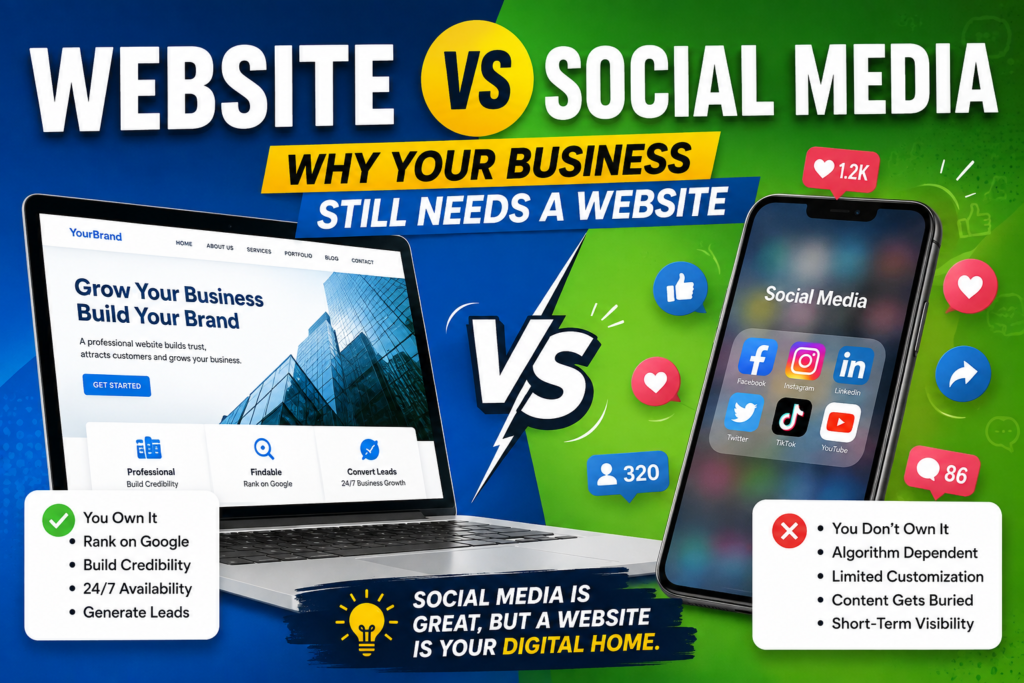
In today’s digital-first business environment, customers expect businesses to be easy to find, easy to trust, and easy to contact online. Social media platforms have become powerful tools for building awareness and communicating with customers, but social media should not be treated as a replacement for a business website.
A Facebook page, Instagram profile, LinkedIn company page, or other social profile can help a business attract attention. However, a professional business website provides something fundamentally different: a digital home that the business controls.
For businesses that want sustainable online visibility, stronger credibility, better search engine presence, lead generation, and long-term growth, having both a website and a social media presence is often the strongest strategy.
Website vs Social Media: What Is the Difference?
The easiest way to understand the difference is to think of your website as your digital headquarters and social media as your digital distribution and communication channels.
Social media platforms are excellent for reaching people where they already spend their time. Businesses can publish posts, videos, offers, announcements, customer stories, educational content, and promotional campaigns.
A website, however, provides a centralized destination where customers can learn everything about the business.
A website can contain:
- Business information
- Products and services
- Pricing information
- Portfolio and case studies
- Customer testimonials
- Contact forms
- Location details
- Frequently asked questions
- Blog articles
- Landing pages
- Online booking
- Product catalogs
- E-commerce functionality
- Downloadable resources
- Lead-generation forms
- Payment systems
- Customer portals
- Business policies
This makes the website a much more flexible digital asset than a social media profile.
Why Social Media Alone Is Not Enough for Your Business
Social media can generate tremendous exposure, but depending entirely on social platforms creates several limitations.
The biggest issue is that you do not own the platform.
Your business operates within rules, algorithms, design structures, advertising systems, and policies controlled by another company. Platform features can change at any time.
Your organic reach may increase or decrease. Features may disappear. Algorithms may change. Advertising costs may rise. Accounts can experience restrictions or technical problems.
A website gives your business much greater control over its digital presence.
Your domain, website content, branding, pages, forms, customer journeys, and website structure can be developed around your specific business objectives.
That ownership becomes increasingly important as your business grows.
1. A Website Builds Professional Business Credibility
Customers often judge a business by its online presence before making contact.
A professional website can immediately communicate that your business is established, organized, and serious about serving customers. Consider a customer searching for a service provider online. They discover two businesses.
The first has only a social media profile with occasional posts.
The second has a professionally designed website containing detailed service information, testimonials, project examples, contact information, FAQs, and helpful articles.
Even if both businesses provide similar services, the second business may appear more credible because the customer has access to more information. A website allows businesses to control this first impression.
A professionally designed website can showcase:
- Brand identity
- Company history
- Expertise
- Services
- Team members
- Previous work
- Certifications
- Testimonials
- Contact information
- Frequently asked questions
- Business achievements
Your website is often the first serious opportunity to turn online attention into customer confidence.
2. Your Website Can Rank on Google
One of the biggest advantages of having a website is the ability to build organic search visibility. When potential customers search Google for services or information, businesses with optimized websites can create pages designed to answer those searches.
For example, a web development company targeting customers in Assam could create useful pages around topics such as:
- Website Development in Guwahati
- Website Design in Assam
- E-commerce Website Development in Assam
- School Website Design in Guwahati
- Hospital Website Design in Guwahati
- Business Website Development
- Mobile App Development in Assam
Each page can target a specific search intent. Social media posts can also appear in search results in certain circumstances, but a dedicated website provides far greater control over SEO structure, content organization, internal linking, metadata, URLs, schema implementation, landing pages, and long-form content.
This makes a website a critical foundation for long-term search engine optimization.
3. Social Media Posts Have a Shorter Content Lifespan
Social media is designed around continuous content consumption. A post may receive significant engagement immediately after publication and then rapidly lose visibility as newer posts appear. This creates a constant need to publish fresh content. A website works differently.
A useful blog article, service page, guide, or resource can continue attracting visitors from search engines for months or even years when it remains relevant and properly maintained.
For example, an article titled:
“The Ultimate Guide to Choosing a Business Website Development Company”
can continue generating organic traffic long after its original publication. This creates an important distinction:
Social media is excellent for ongoing attention. A website is excellent for building long-term digital assets.
4. A Website Gives You Complete Control Over Your Brand
Social media platforms provide predefined layouts and functionality. You can customize your profile to a certain extent, but you are still operating inside someone else’s ecosystem. A website allows much greater freedom.
Your business can control:
- Website layout
- Brand colors
- Typography
- Navigation
- Page structure
- Images
- Content
- Calls to action
- Forms
- Customer journey
- Product presentation
- Service presentation
- Conversion elements
This is especially valuable for businesses with complex products or services. Instead of trying to explain everything through individual social media posts, a website can organize information logically. Visitors can move from:
Homepage → Service → Benefits → Portfolio → Testimonials → FAQ → Contact
This structured journey can help turn visitors into leads.
5. Your Website Can Generate Leads 24/7
A website does not need to wait for a salesperson to become available. It can work continuously as a lead-generation platform. For example, your website can include:
- Contact forms
- WhatsApp buttons
- Call buttons
- Quote request forms
- Consultation forms
- Appointment booking
- Downloadable resources
- Newsletter subscriptions
- Product inquiries
- Service request forms
A visitor can discover your business at midnight, read your service page, understand your offering, and submit an inquiry without speaking to anyone. This makes a website more than an online brochure.
A properly structured website can become a 24/7 sales and lead-generation channel.
6. A Website Can Showcase Your Complete Portfolio
Social media is useful for displaying individual projects, images, videos, and announcements. But a website can turn those individual examples into a structured portfolio. For example, a web development agency can create separate portfolio categories for:
- Corporate Websites
- School Websites
- Hospital Websites
- E-commerce Websites
- Educational Websites
- Business Websites
- Custom Web Applications
- Mobile Applications
Each project can have its own dedicated page. The business can explain the customer’s problem, solution, technology used, features implemented, and results achieved. This creates much more persuasive content than simply posting an image on social media.
7. A Website Helps Customers Find Detailed Information
Social media posts are generally designed to be short, visual, and attention-oriented. Customers sometimes need much more information before making a purchasing decision.
A website can provide detailed explanations without being constrained by the format of a social media feed. For example, a hospital website could provide information about:
- Departments
- Doctors
- Treatments
- Facilities
- Appointment procedures
- Emergency services
- Visiting information
- Health resources
- Frequently asked questions
Similarly, an educational institution can publish:
- Courses
- Eligibility
- Admission information
- Faculty details
- Academic resources
- Fee information
- Results
- Notices
- Contact details
This makes websites particularly important for businesses and organizations where customers need detailed information.
8. Websites Support Local SEO
For local businesses, having a website can significantly strengthen the overall local search strategy. A business targeting customers in Guwahati, for example, can create location-focused pages and useful content that clearly communicates:
- Business location
- Service areas
- Products or services
- Contact information
- Local relevance
- Customer testimonials
- Frequently asked questions
A well-optimized website can complement a business’s Google Business Profile and other online listings. For businesses targeting Assam, location-specific content can also help establish relevance for searches related to cities and service areas.
Examples include:
Website Design in Guwahati
Digital Marketing Company in Guwahati
E-commerce Website Development in Assam
Mobile App Development in Guwahati
The key is to create genuinely useful local content rather than simply repeating a location keyword.
9. Your Website Can Capture Valuable Customer Data
A website gives businesses opportunities to collect first-party information through legitimate and transparent methods. For example:
- Contact forms
- Quote requests
- Newsletter subscriptions
- Consultation forms
- Product inquiries
- Booking requests
- Customer registrations
This information can help businesses understand customer demand and follow up with prospects. Social platforms also provide analytics and advertising tools, but the website can become the central destination where conversions happen.
A social media campaign can attract the visitor.
The website can then convert that visitor into a lead.
This creates a powerful relationship:
Social Media → Website → Lead → Customer
10. A Website Makes Your Business Less Dependent on Algorithms
Social media visibility is strongly influenced by algorithms. A post may reach thousands of people or only a small percentage of followers. Businesses cannot completely control this distribution. Search engines also use algorithms, but website owners have greater control over the content and technical foundation of their own digital property.
Businesses can continuously improve their website by:
- Publishing useful content
- Improving page speed
- Strengthening internal links
- Updating outdated information
- Optimizing pages for search intent
- Improving user experience
- Creating new landing pages
- Building authoritative content
This creates a more sustainable approach to digital visibility.
11. A Website Supports Paid Advertising Better
Social media advertising is powerful, but businesses frequently need a dedicated landing page for campaigns. Instead of sending an advertisement to a generic social media profile, businesses can send users to a focused landing page.
For example:
Facebook Ad → Website Landing Page → Service Information → Lead Form
Or:
Instagram Ad → Product Page → Product Details → Purchase
The landing page can be designed specifically around the campaign objective. This allows businesses to create a more focused customer journey and measure conversions more effectively.
12. Website vs Social Media: Which One Should You Choose?
The answer should not necessarily be website or social media. For most businesses, the better strategy is:
Website + Social Media
Each channel serves a different purpose.
| Feature | Website | Social Media |
|---|---|---|
| Brand ownership | High | Limited |
| SEO potential | Excellent | Limited |
| Long-form content | Excellent | Limited |
| Customer engagement | Good | Excellent |
| Community building | Moderate | Excellent |
| Lead generation | Excellent | Excellent |
| Brand control | High | Limited |
| Portfolio presentation | Excellent | Good |
| Search visibility | Strong | Variable |
| Paid promotion | Excellent | Excellent |
| Customer communication | Good | Excellent |
| Long-term content value | High | Variable |
The strongest digital strategy is therefore not to abandon social media.
Instead, businesses should use social media to drive attention toward a website that they control.
13. How Social Media and Your Website Should Work Together
A successful digital marketing ecosystem can connect multiple channels.
For example:
Google Search → Website → Contact Form → Lead
Instagram → Website → Product Page → Purchase
Facebook → Landing Page → Consultation Request
LinkedIn → Service Page → Business Inquiry
YouTube → Website → Detailed Guide → Lead
This approach allows every platform to perform its strongest function. Social media creates awareness and engagement. Search engines create discovery. The website provides information and conversion. Email can support follow-up. Analytics can help measure performance.
Together, these channels create a stronger digital ecosystem than relying on one platform.
14. What Should a Modern Business Website Include?
A business website does not need hundreds of pages to be effective. However, it should provide the information customers need to make decisions. A professional website may include:
Homepage
Clearly explain who you are, what you offer, who you serve, and what visitors should do next.
About Us
Build trust by explaining your experience, values, expertise, and business background.
Services or Products
Provide detailed information about your main offerings.
Portfolio
Show real examples of previous work.
Testimonials
Use authentic customer feedback to strengthen credibility.
Blog
Publish useful content that answers customer questions and supports SEO.
FAQ
Address common objections and questions.
Contact Page
Make it easy for visitors to call, message, email, or submit an inquiry.
Landing Pages
Create focused pages for specific services, locations, campaigns, or customer segments.
15. Why Small Businesses Especially Need a Website
Small businesses often compete with larger organizations that have stronger brand recognition. A professional website can help level the playing field. A small business can use its website to demonstrate:
- Expertise
- Customer service
- Experience
- Local knowledge
- Previous projects
- Product quality
- Customer reviews
- Unique advantages
A well-designed website can make a small business appear more established and easier to evaluate. For local service providers, this can be particularly valuable. When customers search for a service online, businesses without a website may have fewer opportunities to provide comprehensive information and capture those visitors.
16. A Website Is an Investment, Not Just an Expense
It is easy to view website development as another business expense. A better perspective is to consider the website as a digital business asset.
A website can:
- Attract organic traffic
- Generate leads
- Support advertising
- Build credibility
- Showcase products
- Educate customers
- Answer questions
- Collect inquiries
- Support sales
- Strengthen branding
Unlike a one-time social media post, a website can continue serving these functions for years.
Of course, the effectiveness of a website depends on its quality. A slow, outdated, confusing website may not deliver the desired results. The goal should therefore be to build a website that is fast, mobile-friendly, secure, user-focused, search-engine-friendly, and conversion-oriented.
17. Mobile-Friendly Website Design Is Essential
A significant portion of online browsing happens on smartphones. This means your website must work properly across:
- Smartphones
- Tablets
- Laptops
- Desktop computers
A responsive website should automatically adapt its layout to different screen sizes.
Navigation should be easy.
Buttons should be easy to tap.
Text should be readable.
Forms should be simple.
Images should load efficiently.
A poor mobile experience can cause visitors to leave before they contact your business.
Therefore, responsive website design is no longer optional for a modern business website.
18. Website Security and Trust Matter
Businesses also need to consider security. A professional website should use HTTPS and follow appropriate security practices. Depending on the website’s functionality, businesses may also need:
- Secure hosting
- Regular backups
- Software updates
- Malware protection
- Strong authentication
- Form protection
- Privacy policies
- Secure payment processing
Security is particularly important for websites that collect customer information, process payments, or provide user accounts. A secure and professionally maintained website contributes to customer confidence.
19. The Website Should Have a Clear Call to Action
A website should not simply provide information. It should guide visitors toward the next step.
Examples include:
Request a Quote, Book a Consultation, Call Us Today, Get Started, Shop Now, Enquire Now
Schedule an Appointment, Download Brochure
The appropriate call to action depends on the business model. For a service company, a consultation or quotation request may be appropriate. For an e-commerce business, the goal may be to add products to the cart. For an educational website, the desired action could be course enrollment or admission inquiry.
The website should be designed around the desired conversion.
20. The Future of Business Is Not Website vs Social Media
The real question is not whether businesses should use websites or social media. The better question is:
How can both channels work together to grow the business?
Social media can attract attention.
Search engines can introduce new customers to your business.
Your website can educate visitors.
Landing pages can convert them.
Forms can capture inquiries.
Email and messaging can support follow-up.
Analytics can help measure results.
This creates a complete digital customer journey.
Final Verdict: Why Your Business Still Needs a Website
Social media is powerful, but it should complement your website rather than replace it. Your social media profiles help you communicate with audiences, build communities, showcase content, and generate attention.
Your website gives your business a central digital platform where you control the brand experience, publish detailed information, build search visibility, generate leads, showcase your expertise, and convert visitors into customers.
For businesses serious about long-term digital growth, the ideal strategy is simple:
Build a professional website. Optimize it for search engines. Keep it useful and updated. Use social media to promote it. Turn visitors into leads and customers. A social media profile can help people discover your business today.
A strong website can help your business build digital value for years.
Build a Website That Works for Your Business
Ready to establish a stronger online presence? Pragnya Digital Solutionz helps businesses create professional, responsive, SEO-friendly websites designed around their brand, customers, and business goals.
Whether you need a business website, e-commerce website, school website, hospital website, educational portal, portfolio website, or custom web solution, the right digital foundation can help your business compete and grow online.
Build your digital presence with Pragnya Digital Solutionz and turn your website into a powerful business asset.