
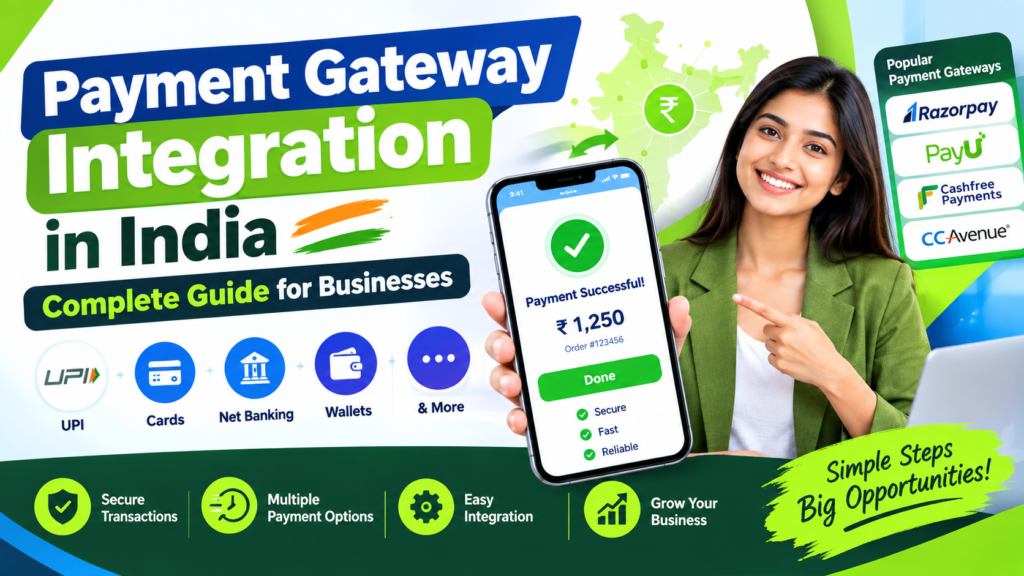
In today’s digital economy, accepting online payments is essential for businesses that sell products or services through websites and mobile applications. Payment gateway integration in India allows businesses to accept payments securely through multiple methods, including credit cards, debit cards, UPI, net banking, and digital wallets.
For an e-commerce store, service marketplace, educational platform, booking website, subscription business, or mobile application, a properly integrated payment gateway can make the checkout experience faster and more convenient while helping businesses manage online transactions efficiently.
This guide explains the important aspects of payment gateway integration in India, including how payment gateways work, available payment methods, integration options, security considerations, costs, and the process of connecting a payment gateway with a website or mobile application.
What Is Payment Gateway Integration?
A payment gateway is a technology that enables a business to accept online payments from customers. Payment gateway integration is the process of connecting the payment gateway with a website, e-commerce platform, mobile application, or other digital system.
When a customer places an order and selects an online payment option, the integrated gateway securely processes the transaction and communicates the payment status to the merchant’s system.
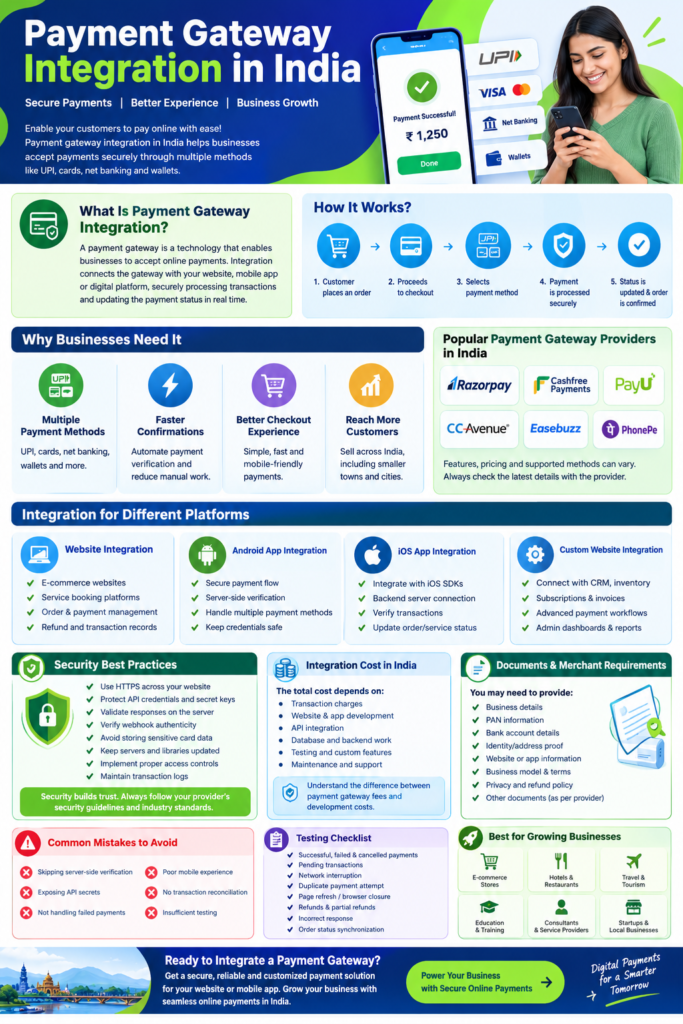
A typical transaction involves several stages:
- The customer selects a product or service.
- The customer proceeds to checkout.
- The payment gateway displays available payment options.
- The customer selects a preferred payment method.
- Payment information is securely processed.
- The payment service communicates the transaction result.
- The website or application receives the payment status.
- The order or service status is updated accordingly.
A properly implemented integration should also handle successful payments, failed payments, cancelled transactions, pending transactions, refunds, and payment verification.
Why Businesses Need Payment Gateway Integration in India
India has a large and rapidly growing digital payment ecosystem. Customers increasingly expect businesses to provide convenient online payment options instead of relying only on cash or manual bank transfers.
Integrating a payment gateway can provide several practical advantages.
1. Accept Multiple Payment Methods
A modern payment gateway can provide customers with multiple ways to pay. Depending on the gateway and merchant configuration, these may include:
- UPI
- Credit cards
- Debit cards
- Net banking
- Digital wallets
- Other supported payment methods
Providing multiple options can make the checkout process more convenient for different types of customers.
2. Automate Payment Confirmation
Manual payment verification can consume considerable time. With gateway integration, transaction responses can automatically be communicated to the website or application.
For example, an e-commerce website can automatically mark an order as paid after receiving and verifying a successful payment notification.
3. Improve the Checkout Experience
A complicated checkout process can create unnecessary friction. A well-designed payment flow can allow customers to complete transactions with fewer steps.
The payment interface should be mobile-friendly, clear, fast, and easy to understand.
4. Support Online Businesses Across India
Businesses based in metropolitan cities as well as smaller cities and towns can use online payment infrastructure to sell products and services to customers in different parts of the country.
For businesses operating in Guwahati, Assam, Northeast India, and other regions, payment gateway integration can be particularly useful when expanding beyond a local customer base.
Popular Payment Gateway Options in India
Businesses can choose from several payment service providers operating in the Indian market. The appropriate choice depends on factors such as transaction requirements, payment methods, technical capabilities, settlement arrangements, business model, and commercial terms.
Examples of commonly encountered payment gateway providers include:
- Razorpay
- Cashfree Payments
- PayU
- CCAvenue
- Easebuzz
- PhonePe Payment Gateway
- Other providers offering merchant payment solutions
Features, pricing, onboarding requirements, supported payment methods, and APIs can change over time, so businesses should verify current terms directly with the selected provider before implementation.
Payment Gateway Integration for Websites
A website can integrate a payment gateway in several ways depending on its technology and business requirements.
E-Commerce Website Integration
An e-commerce website generally requires payment integration for:
- Product purchases
- Shopping cart checkout
- Order confirmation
- Payment verification
- Refund processing
- Transaction records
The integration should connect the payment status with the website’s order management system.
For example:
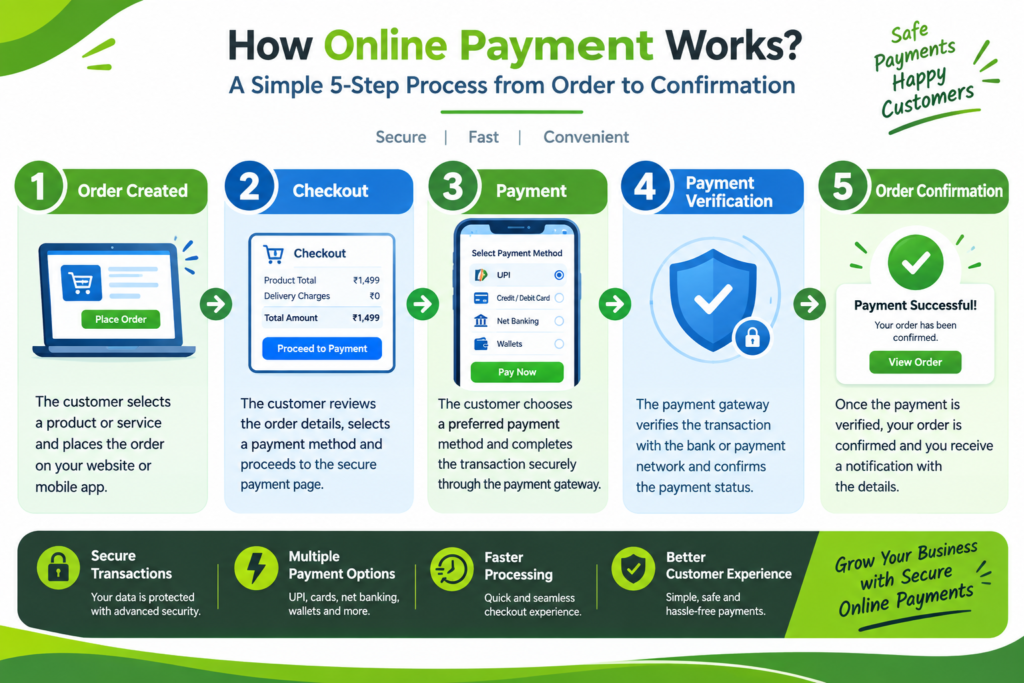
Order Created → Checkout → Payment → Payment Verification → Order Confirmation
The system should not rely solely on the customer’s browser redirect to determine whether money was successfully received. The server-side payment response or provider-supported verification mechanism should also be used.
Service Website Integration
Service businesses can integrate online payments for:
- Service bookings
- Consultation fees
- Advance payments
- Registration fees
- Project deposits
- Event registrations
- Digital services
This allows customers to make payments directly through the website instead of contacting the business for manual payment instructions.
Payment Gateway Integration for Android Applications
Mobile applications can also integrate payment gateways to support transactions directly inside the customer journey.
For an Android application, the integration may involve:
- Creating an order or payment request.
- Sending the required information to the payment system.
- Opening the appropriate payment interface.
- Allowing the customer to complete the transaction.
- Receiving the transaction response.
- Verifying the payment on the server.
- Updating the application account, order, or service status.
For security reasons, sensitive credentials and secret keys should not be embedded directly inside the mobile application.
Payment Gateway Integration for iOS Applications
Businesses offering iPhone and iPad applications can similarly implement payment functionality according to the applicable payment provider and Apple’s requirements.
The development process normally involves coordinating:
- The iOS application
- Backend server
- Payment gateway APIs or SDKs
- Merchant account
- Transaction verification
- Order or service database
A secure server-side architecture is important because payment status should be independently verified rather than trusting data supplied solely by the client application.
How Payment Gateway Integration Works
A typical payment gateway architecture consists of several components.
Customer Interface
The customer begins the transaction through the website or mobile application.
Backend Server
The backend creates the appropriate payment request and communicates with the payment provider.
Payment Gateway
The gateway processes the transaction through the selected payment method.
Bank or Payment Network
The relevant financial institution or payment network authorizes and processes the transaction.
Transaction Response
The payment provider communicates the result back to the merchant system.
Payment Verification
The merchant’s server verifies the transaction before marking the order or service as successfully paid.
This architecture helps create a more reliable payment process.
Important Features of Payment Gateway Integration
When developing a payment-enabled website or application, businesses should consider more than simply adding a payment button.
Payment Verification
The application should verify transactions using the payment provider’s recommended server-side mechanisms.
Webhook Integration
Payment providers may provide webhooks that notify the merchant server when transaction events occur.
Webhooks can be useful for handling situations where the customer closes the browser or loses internet connectivity after completing payment.
Transaction Status Management
A robust system should distinguish between:
- Successful
- Failed
- Pending
- Cancelled
- Refunded
- Partially refunded, where supported
Refund Management
Businesses may need functionality for processing or recording refunds.
Transaction Records
Important payment information should be recorded securely so businesses can reconcile orders and transactions.
Error Handling
The system should provide useful messages when transactions fail without exposing sensitive technical information.
Security in Payment Gateway Integration
Payment security should be a fundamental consideration during gateway integration.
Businesses should follow the payment provider’s official security requirements and implementation documentation.
Important practices include:
- Use HTTPS across the website.
- Protect API credentials and secret keys.
- Never expose private credentials in frontend code.
- Validate payment responses on the server.
- Verify webhook authenticity according to provider documentation.
- Avoid storing sensitive card information unless specifically authorized and appropriately compliant.
- Maintain secure server configurations.
- Keep payment-related libraries and dependencies updated.
- Implement appropriate access controls.
- Maintain transaction logs without unnecessarily storing sensitive information.
Businesses should also understand their responsibilities under applicable laws, regulations, contractual requirements, and payment-industry standards.
Payment Gateway Integration Cost in India
The total cost of payment gateway integration can vary significantly depending on the project.
Potential cost components include:
- Payment gateway transaction charges
- Gateway onboarding or account-related charges, if applicable
- Website development
- Mobile application development
- Backend development
- API integration
- Database development
- Testing
- Custom checkout development
- Refund and transaction management
- Maintenance and technical support
For a basic website, integration may be relatively straightforward. A complex marketplace or subscription platform can require considerably more backend development.
Therefore, businesses should distinguish between payment gateway transaction fees and the development cost of integrating the gateway.
Documents and Merchant Requirements
Payment gateway providers generally conduct merchant onboarding and verification before enabling live transactions. Requirements can vary depending on the business structure and provider.
Businesses may be asked to provide information such as:
- Business details
- PAN-related information
- Bank account details
- Identity or address documentation
- Website or application information
- Business model information
- Terms and conditions
- Privacy policy
- Refund and cancellation policy
- Other documents required for verification
The exact requirements should always be confirmed with the selected payment provider.
Payment Gateway Integration for WordPress and WooCommerce
Businesses using WordPress and WooCommerce can often integrate payment gateways through compatible plugins or custom development.
A typical implementation may include:
WooCommerce Store → Checkout → Payment Gateway → Payment Verification → Order Status
Before installing a plugin, businesses should verify its compatibility with the current versions of WordPress, WooCommerce, PHP, and the selected payment provider.
Custom integration may be appropriate when the website requires functionality beyond the capabilities of an existing plugin.
Payment Gateway Integration for Custom Websites
Custom-built websites provide greater flexibility for businesses with specialized requirements.
A custom integration can connect payment processing with:
- Customer accounts
- Product inventory
- Booking systems
- CRM systems
- Subscription management
- Invoices
- Membership systems
- Order management
- Automated notifications
- Administrative dashboards
For complex projects, the payment architecture should be planned before development rather than added as an afterthought.
Common Payment Gateway Integration Mistakes
Several implementation mistakes can create transaction or operational problems.
Ignoring Server-Side Verification
A successful browser redirect does not necessarily provide sufficient confirmation for a transaction.
Exposing API Secrets
Private credentials should never be placed in publicly accessible frontend code or mobile application binaries.
Not Handling Failed Payments
The system should provide customers with a clear recovery path after failed transactions.
Poor Mobile Experience
Since many customers use smartphones for online transactions, the payment experience should be responsive and easy to navigate.
No Transaction Reconciliation
Businesses should have a method to compare website orders with gateway transactions and settlement records.
Insufficient Testing
Payment systems should be thoroughly tested using the provider’s test environment before going live.
Payment Gateway Integration Testing
Before launching the system, developers should test different scenarios.
A useful testing checklist includes:
- Successful payment
- Failed payment
- Cancelled payment
- Pending payment
- Network interruption
- Duplicate payment attempt
- Duplicate webhook
- Page refresh during checkout
- Browser closure after payment
- Refund
- Partial refund where supported
- Incorrect payment response
- Order status synchronization
Testing these situations helps identify problems that may not appear during a simple successful-payment test.
Choosing a Payment Gateway Integration Service
Businesses looking for payment gateway integration in India should evaluate both the payment provider and the development team responsible for implementation.
A professional integration service should understand:
- Website development
- Android application development
- iOS application development
- Backend APIs
- Database systems
- Payment verification
- Webhooks
- Security practices
- Testing and deployment
For businesses in Guwahati and Northeast India, working with a local web and app development company can also make communication, customization, and ongoing support more convenient.
Payment Gateway Integration in India for Growing Businesses
Online payments are no longer limited to large e-commerce companies. Small businesses, startups, educational institutions, consultants, hotels, restaurants, travel businesses, service providers, and local entrepreneurs can use online payment infrastructure to accept digital transactions.
A properly implemented payment system can connect the customer’s purchase journey with the business’s internal order and accounting processes.
For example:
Customer Visits Website → Selects Service → Completes Checkout → Pays Online → Payment Verified → Order Confirmed → Business Receives Transaction Record
This creates a structured digital transaction process instead of relying on manual payment confirmation.
Final Thoughts on Payment Gateway Integration
Payment gateway integration in India is an important component of modern websites and mobile applications that accept online payments. The right implementation should go beyond simply connecting a payment button. It should provide secure transaction processing, reliable payment verification, appropriate error handling, transaction tracking, refund support, and a smooth customer experience.
Whether the requirement is for an e-commerce website, business website, Android application, iOS application, booking platform, educational portal, or custom web application, the payment architecture should be designed around the business’s specific requirements.
A carefully planned payment gateway integration can help create a convenient digital payment experience while providing businesses with a structured way to manage online transactions.